Published September 22, 2026
How to Manage a Rental Property Remotely: The 2026 Guide

Can you successfully run a rental from hundreds of miles away without handing a quarter of your revenue to a management agency? Most owners assume long-distance hosting forces an unfair choice: handle middle-of-the-night plumbing emergencies yourself, or surrender your profit margins to steep management commissions. The anxiety over unauthorized parties, contractor no-shows, and sudden repairs is real. Fortunately, mastering how to manage a rental property remotely no longer requires hiring an expensive middleman to watch over your investment.
You can build an efficient operation that keeps overhead predictable while maximizing your rental income. In this guide, you'll learn how to operate a profitable rental property from anywhere using simple technology, trusted local support, and low-overhead management systems. We'll walk through vetting reliable cleaners, coordinating on-site check-ins, and structuring day-to-day guest communication so your property runs smoothly while you stay in full control.
Key Takeaways
- Master how to manage a rental property remotely by setting up clear standard operating procedures for guest check-ins, routine maintenance, and turnover logistics.
- Assemble an essential tech stack using smart hardware and secure payment processing to automate access and protect rental transactions without hands-on effort.
- Build an on-the-ground support roster of reliable cleaners and trusted tradespeople equipped with photographic checklists to verify quality after every checkout.
- Compare full-service property management fees against low-overhead, flat-fee listing models to protect net profit margins and maintain total control over your asset.
Table of Contents
The Core Foundations of Managing a Rental Property Remotely
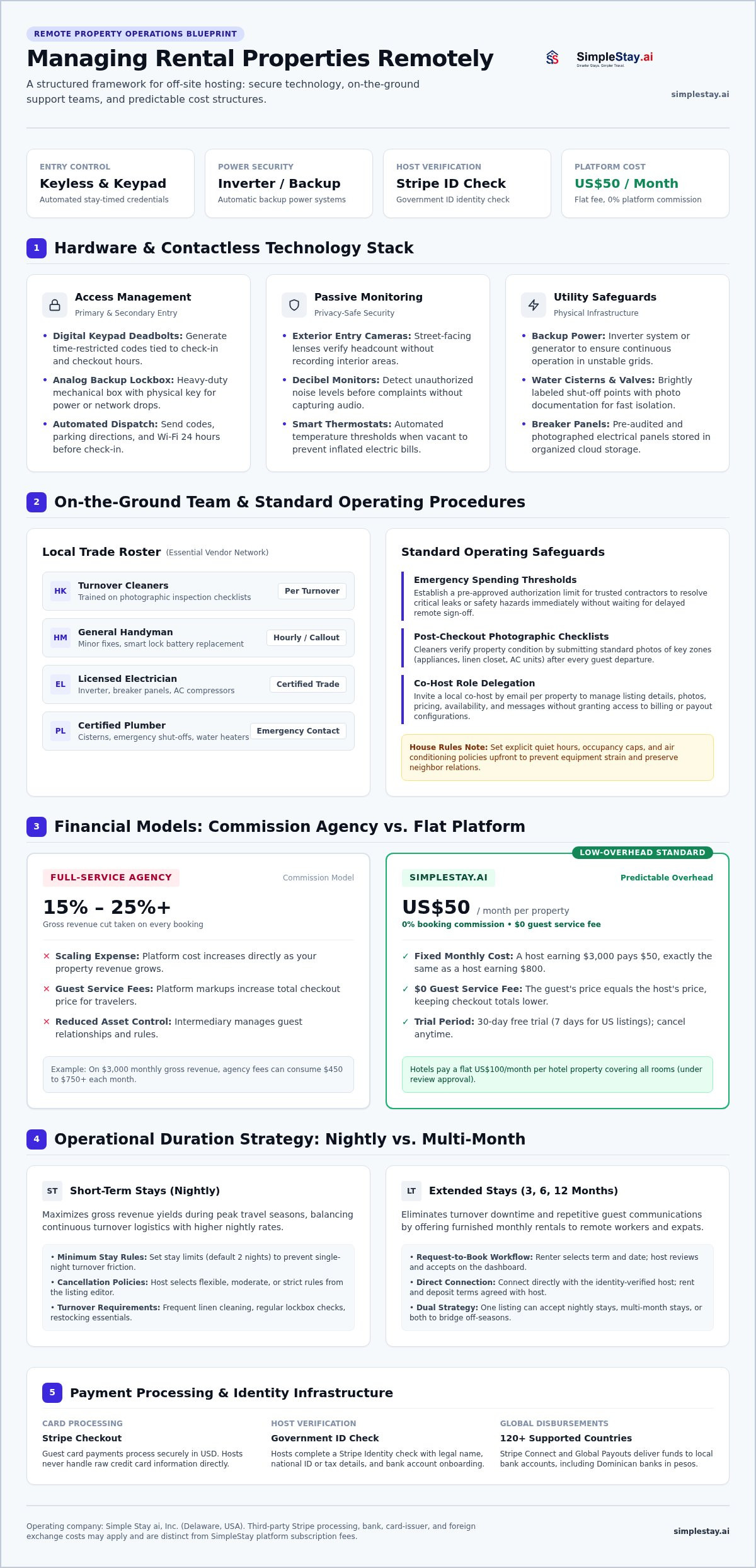
Traditional property management once required physical proximity, but remote systems decouple an owner's physical location from daily property performance. Truly mastering how to manage a rental property remotely means building documented standard operating procedures (SOPs) before welcoming your first guest. Create structured response templates for check-ins, scheduled quarterly inspection workflows, and a clear escalation hierarchy for contractor emergencies. Set firm house rules upfront covering quiet hours, strict maximum occupancy limits, and sensible air conditioning usage policies to protect mechanical equipment and maintain neighbor relations.
Assessing Your Property Readiness for Off-Site Operations
Off-site hosting requires bulletproof physical infrastructure. Audit high-risk utilities before handing over keys, specifically water heaters, electrical breaker panels, and air conditioning compressors. Tag all primary water shut-off valves with bright labels, then document their exact locations with photos so guests and emergency contractors can isolate leaks within minutes. If your property is located in an area with an unstable electrical grid, install an automatic inverter system or backup generator to keep essentials running and avoid sudden cancellations.
Choosing Your Rental Strategy: Short-Term vs. Extended Stays
Your operational model directly dictates your remote workload. Nightly vacation bookings generate higher gross returns, but they demand continuous turnover coordination, frequent linen cleaning, and constant guest communication. Offering flexible three- to twelve-month stays cuts operational friction, virtually eliminates turnover downtime, and locks in predictable monthly revenue. For example, looking at regional trends like Dominican Republic apartment rentals illustrates how combining peak-season short stays with multi-month off-season rentals stabilizes annual cash flow without overburdening your support team.
How to Build a Reliable Remote Management Tech Stack
An effective remote tech stack replaces manual oversight with connected hardware and trusted payment processing. Contactless check-in means a secure entry system allowing guests to access a rental using automated digital credentials without meeting an owner in person. When establishing access, maintain strict compliance with local landlord-tenant law regarding privacy and physical security. Pair these physical tools with reliable card processing through Stripe Checkout to handle guest payments securely. When deciding how to manage a rental property remotely, pick software that triggers direct notifications for booking requests and incoming messages rather than requiring constant dashboard monitoring.
Keyless Entry and Access Automation
Smart locks form the backbone of distance management. Install Wi-Fi or keypad deadbolts that generate time-restricted entry codes matching the exact check-in and checkout hours of each stay. Always mount a heavy-duty mechanical lockbox with an analog backup key on the exterior wall in case batteries fail or internet connections drop. Configure automated arrival messages 24 hours prior to check-in with door codes, exact parking directions, and Wi-Fi access details.
Remote Property Monitoring and Security
Protecting your property from afar requires passive monitoring tools that respect guest boundaries. Install exterior entryway cameras pointing toward street access points to verify headcount without capturing interior living spaces. Complement these with privacy-safe decibel monitors that flag potential unauthorized parties before neighbors complain, without recording audio content. Smart thermostats prevent inflated electric bills by applying automated temperature limits when the unit sits empty between stays. To run your rentals with direct guest messaging and simple operational controls, register as an owner on SimpleStay.
Assembling Your On-the-Ground Support Team
Understanding how to manage a rental property remotely relies entirely on the strength of your local contacts. Build a dependable vendor roster consisting of vetted housekeepers, skilled handymen, licensed electricians, and certified plumbers. Store digital copies of appliance warranties, equipment manuals, and utility contacts in an organized cloud folder. Establish clear emergency authorization thresholds, granting trusted contractors immediate approval to resolve critical leaks or safety hazards up to a defined spending limit without waiting for your delayed remote sign-off.
Vetting and Compensating Reliable Turnover Specialists
Run paid trial cleanings on vacant turnover days before scheduling live arrivals. Provide structured visual checklists requiring time-stamped photos of freshly made beds, spotless bathrooms, and restocked supplies before clearing invoices. Implement simple inventory checklists to track linen conditions and guest supplies across stays. Paying your cleaning team promptly through digital bank transfers upon receiving photographic verification builds strong loyalty and keeps standards high.
Working with a Local Co-Host
You don't need an expensive management firm when an individual local partner can handle physical presence. Assign day-to-day operational tasks like in-person property inspections, vendor coordination, and key handoffs to a trusted co-host. Modern listing platforms allow you to invite a co-host by email, giving them access to manage availability and guest messages from their dedicated dashboard while your billing and payout settings remain completely private. For deeper strategies on running exceptional stays from afar, study our guide on mastering BNB hosting.
Comparing Remote Management Models: Full-Service Agency vs. Flat-Fee Platform
Choosing your operating structure determines whether off-site ownership builds real equity or drains your returns. Deciding how to manage a rental property remotely comes down to two models: surrendering income to a traditional agency or retaining control through flat-fee software.
| Feature | Full-Service Agency | Flat-Fee Platform |
|---|---|---|
| Cost Structure | 10% to 25%+ of gross revenue | Predictable flat fee |
| Operational Control | Agency dictates rules and pricing | Owner controls calendar and rates |
| Guest Contact | Third-party representatives | Direct host-to-guest messaging |
| Maintenance | Vendor markups on repairs | Local contractors hired at direct cost |
The Hidden Operational Costs of Traditional Property Managers
Traditional management contracts quietly erode net margins. Beyond base monthly commissions, agencies often bill placement fees, renewal charges, and 10% to 15% markups on basic maintenance repairs. Percentage-based commissions also penalize your success. When you raise nightly rates, an agency takes a larger cut for the exact same labor. You also lose direct communication with guests, leaving you blind to property issues.
The Flat-Fee Direct Approach for Modern Remote Hosts
Modern operators use transparent tools to protect cash flow. On SimpleStay, hosts pay a flat US$50 monthly fee per property with 0% booking commission, while guests pay $0 in service fees. You retain complete control over your nightly pricing, seasonal calendar blocks, and direct messaging through your Host dashboard, whether coordinating vacationers or hosting multi-month digital nomad rentals.
Start Operating Your Remote Rental with Confidence
Running a successful rental from afar doesn't require sacrificing your profits to high agency fees. Mastering how to manage a rental property remotely comes down to three clear essentials: dependable access hardware, documented turnover checklists, and a reliable local contractor roster. When you pair smart entry tools with an on-site co-host, your property operates smoothly no matter where you live.
Modern platforms make independent ownership practical and profitable. SimpleStay gives you full operational control for a flat US$50 per month listing fee with 0% booking commission, so you keep your earnings before third-party payment-processing fees apply. Every owner can earn an official Verified Host badge after completing an ID check, backed by a 30-day free trial on new listings with no long-term contracts.
Take charge of your rental strategy today, keep your operating costs predictable, and build long-distance equity on your own terms.
Frequently Asked Questions
Can you legally manage a rental property remotely without a license?
In most jurisdictions, you can legally manage your own rental property without a real estate license. Licensing requirements generally apply only to third-party individuals or brokerages managing properties for someone else. However, short-term rental regulations, local tax collection, and zoning laws vary significantly across cities like Miami or Santo Domingo. Always consult municipal housing rules or a qualified legal professional to verify registration requirements for your specific property.
What happens if a plumbing or maintenance emergency occurs at 2 a.m.?
Managing urgent repairs effectively requires prearranged emergency protocols rather than middle-of-the-night panic. Provide incoming guests with clear shut-off instructions for main water and gas valves. Give your vetted local plumber or on-the-ground co-host pre-approved authorization to execute emergency repairs up to a set budget limit. This structure lets your local contact dispatch immediate fixes right away while keeping your liability contained and your sleep uninterrupted.
How do remote property owners handle guest key handoffs securely?
Remote owners handle arrivals securely by deploying keypad smart locks alongside a backup exterior lockbox. When learning how to manage a rental property remotely, automated digital codes eliminate physical key handoffs completely. You generate unique access codes programmed to activate strictly during the reservation window. A physical lockbox containing a traditional master key remains mounted outside as a reliable fallback if batteries drain or the local internet drops.
Is hiring a full-service property management company worth the commission cost?
Full-service property management rarely makes financial sense for owners willing to set up simple software systems. Agencies typically take 10% to 25% of gross rental income, plus maintenance markups and leasing fees. By using modern flat-fee platforms and pairing them with a trusted local co-host, you retain your profit margins and maintain total control over nightly pricing without paying escalating commissions on every booking you earn.
How do out-of-state or international owners receive rental payouts reliably?
International owners receive earnings reliably by integrating verified payment processors like Stripe. A core aspect of how to manage a rental property remotely across borders is avoiding manual wire transfers. Modern booking tools route guest card payments through Stripe Checkout, forwarding settled funds directly to your local bank account in over 120 supported countries, including accounts in US dollars or Dominican pesos via Stripe Global Payouts.

Article by
Jaime Robledo, MBA
Jaime Robledo, MBA, is a technology leader, entrepreneur, and founder based in Santo Domingo, Dominican Republic, with more than two decades of experience building, modernizing, and securing enterprise technology environments. His career has spanned consulting, media, finance, education, healthcare, and large-scale corporate IT, with deep expertise in Microsoft technologies, cloud infrastructure, endpoint management, automation, cybersecurity, AI, and digital transformation.
Throughout his career, Jaime has led complex technical initiatives involving Microsoft Intune, Microsoft 365, Defender, SCCM, Azure, PowerShell, DevOps, Windows modernization, and enterprise infrastructure. His experience combines hands-on engineering, technical leadership, business strategy, and execution.
Today, Jaime is focused on building technology companies designed specifically for Latin America. He is the founder of SimpleStay.ai, a rental and hospitality platform created to make booking, hosting, rent payments, and property management more transparent and affordable through flat pricing, zero guest service fees, secure payments, identity verification, and support for short-term, hotel, and long-term rentals.
He also built United Empresas, a marketplace connecting customers with local service professionals for discovery, booking, payments, and business growth.
Beginning in January, Jaime will also be building a new fintech platform in public, focused on making digital payments and money movement simpler and more accessible across Latin America.
Across every venture, Jaime’s mission is the same: use technology, AI, automation, and practical business systems to reduce friction, create jobs, strengthen small businesses, expand financial access, and improve people’s lives throughout Latin America.