Published September 23, 2026
How to Become a Host in the Dominican Republic: The 2026 Step-by-Step Guide
With over 7.7 million visitors arriving in the Dominican Republic in the first seven months of 2026 alone, traveler demand is breaking records. If you are figuring out how to become a host in the Dominican Republic, that steady stream of guests is exciting, but local logistics can quickly feel intimidating. You might worry about sudden power outages, water cistern maintenance, or high marketplace commissions quietly eating into your rental earnings. That hesitation is completely natural, because running a Caribbean vacation rental requires practical utility planning rather than generic advice.
You don't need years of hospitality experience to build a reliable, well-run rental business. In this guide, you will learn the exact amenities required to keep guests comfortable, how to protect your margins with predictable platform costs, and how to set up direct bank payouts to your local Dominican account. Here is your step-by-step roadmap to preparing your space and hosting your first reservation with confidence.
Key Takeaways
- Verify your condominium bylaws, ownership permissions, and DGII tax registrations before listing your property.
- Install backup power solutions like an inversor and verify water cistern capacity to prevent negative guest reviews.
- Learn how to become a host in the Dominican Republic with accurate listing details, clear photography, and transparent house rules.
- Protect your rental profits by choosing predictable flat-fee platform pricing and setting up direct bank payouts in pesos.
Table of Contents
Understanding the Requirements for Hosting in the Dominican Republic
Launching a rental business starts with establishing clear legal authority and operational compliance. Before exploring how to become a host in the Dominican Republic, confirm that your paperwork is in order. You must hold legal property ownership documentation or possess written sublease authorization directly from the title holder. Operating without explicit permission risks immediate closure and fines.
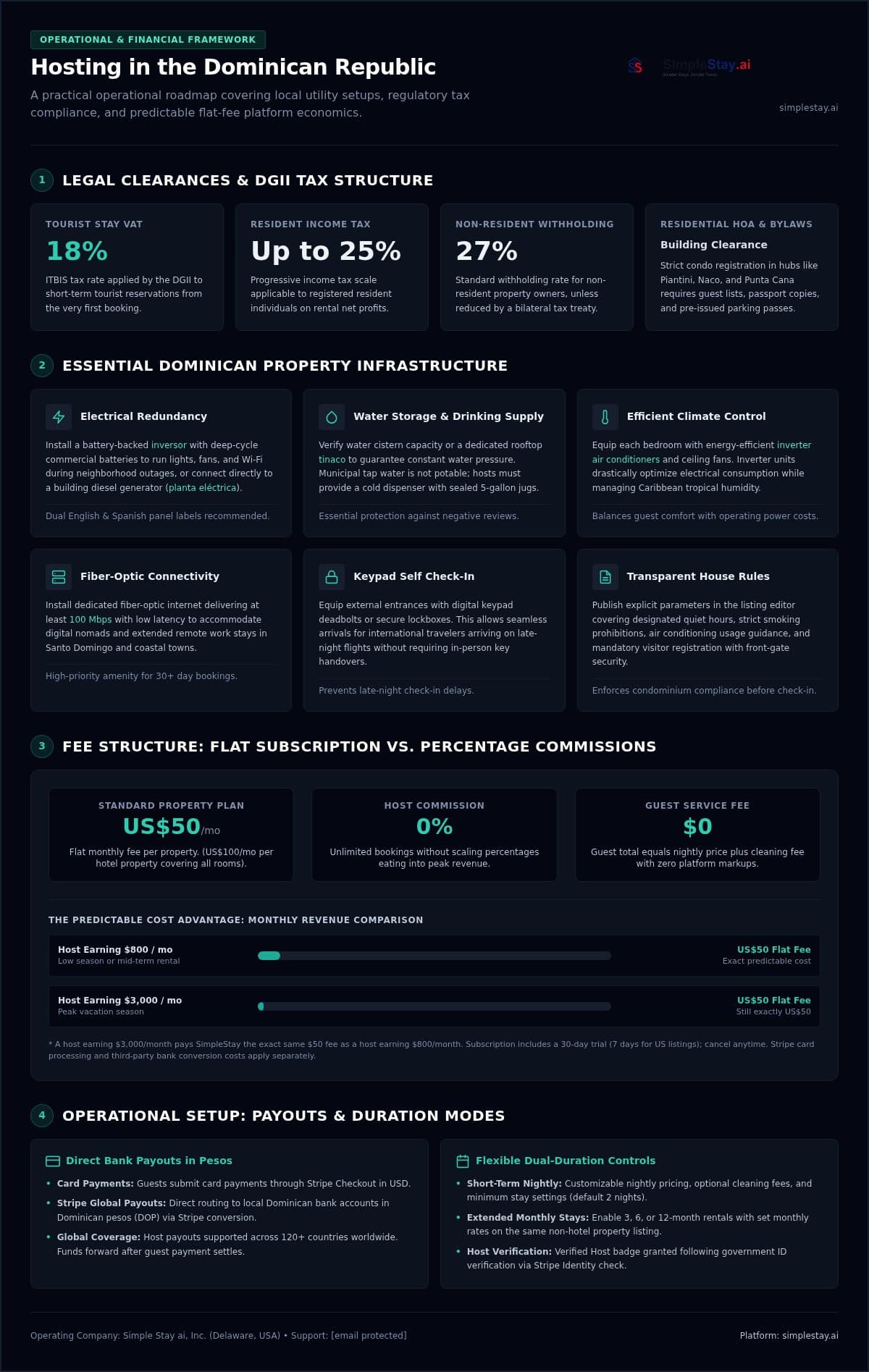
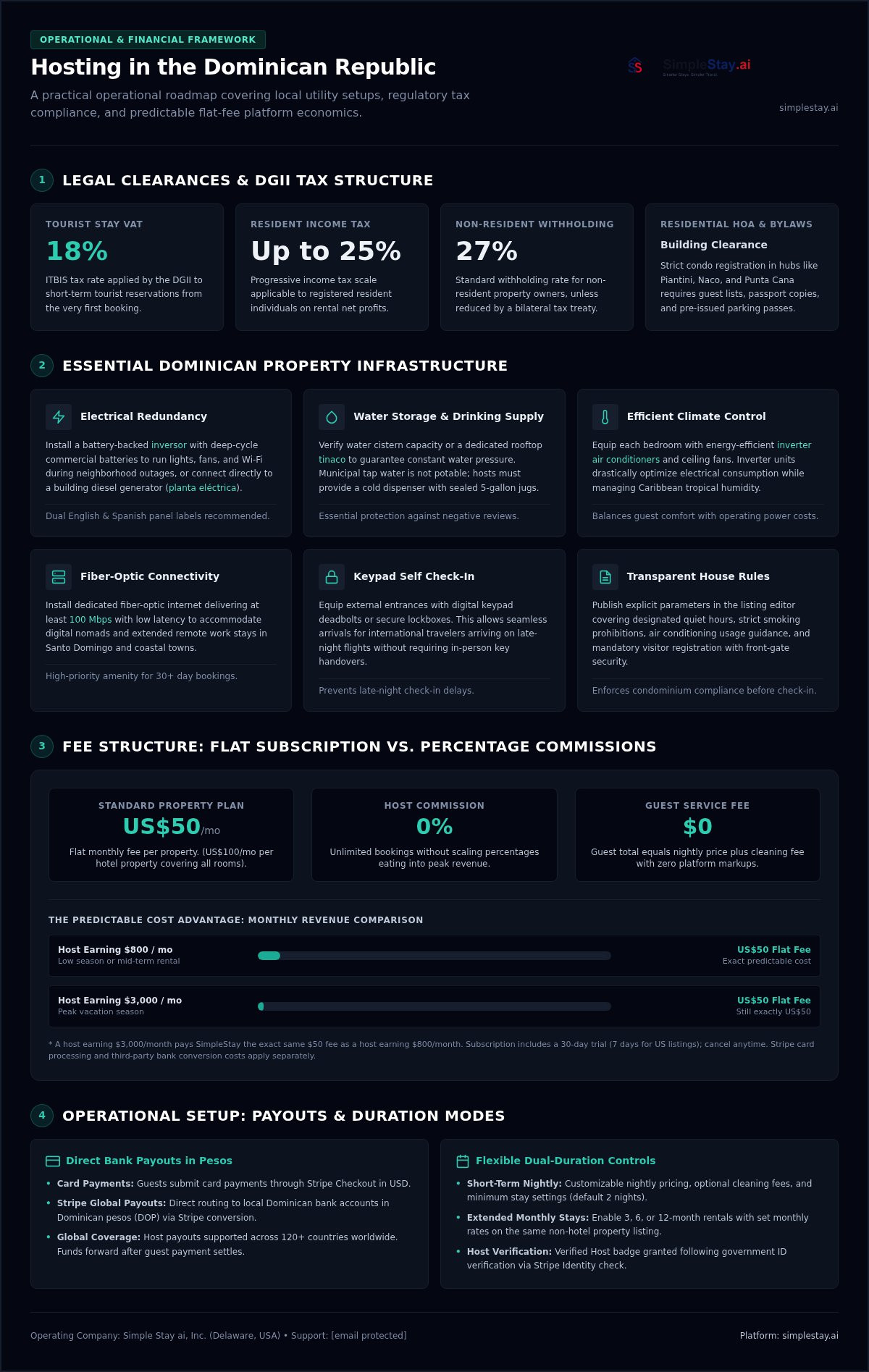
Local compliance also means registering your activity with the Dirección General de Impuestos Internos (DGII). Short-term tourist stays incur an 18% Value Added Tax (ITBIS), which applies starting from your very first reservation. Individual residents face progressive income taxes up to 25%, while non-resident property owners face a 27% withholding tax unless reduced by an applicable bilateral treaty. Always consult a qualified local accountant to set up your tax registry (RNC) correctly.
Legal Clearances and Condominium Rules
Condominium bylaws dictate whether your building permits short-term rentals. High-demand residential areas across Santo Domingo (such as Piantini and Naco) and Punta Cana often enforce specific Homeowners Association (HOA) rules. Front desks and security gates usually require written guest registration lists, passport copies, and pre-approved parking passes before releasing keys. Always confirm these residential policies in writing.
Choosing Between Short-Term Stays and Monthly Rentals
Decide whether your property best serves transient vacationers or remote workers looking for longer commitments. The sustained growth of tourism in the Dominican Republic keeps nightly demand steady in resort corridors, delivering high peak revenue. In contrast, urban apartments in commercial hubs thrive by offering flexible 3, 6, or 12-month rentals. Assessing local tenant profiles helps you set the right availability model for your unit.
Preparing Your Dominican Property: Essential Utilities and Amenities
Travelers expect comfort, but Caribbean infrastructure often presents unique utility challenges. Understanding these regional realities is the most critical operational step when learning how to become a host in the Dominican Republic. While the Dominican Republic's economic growth continues to modernize urban centers, temporary grid disruptions still happen. Equipping your home with dependable backup systems protects your reviews and prevents midnight emergencies.
Backup Power and Potable Water Systems
Electrical stability makes or breaks a stay. Install an inversor with deep-cycle commercial batteries to keep fans, lights, and Wi-Fi running through neighborhood power cuts. If your apartment building has a full-capacity diesel generator (planta eléctrica), verify that your unit's breaker ties into it. Pair electrical redundancy with an adequate water cistern or rooftop tinaco to maintain water pressure. Municipal tap water is not suitable for drinking, so always provide a cold-water dispenser with sealed 5-gallon jugs.
- Climate control: Install inverter air-conditioning units and ceiling fans in every bedroom to manage tropical humidity efficiently.
- Instructions: Label your battery inverter panel with simple English and Spanish operating notes for incoming guests.
Work-Ready Connectivity and Security
Equipping an apartment for digital nomads requires low latency and security. Fiber-optic connections delivering at least 100 Mbps attract remote workers seeking longer stays in areas like Las Terrenas or Santo Domingo. Add a keypad deadbolt or lockbox so guests arriving on late flights can self-check-in without waiting outside. Once your property features these essentials, you can register your apartment to begin welcoming your first reservations.
Step-by-Step Guide to Creating an Effective Rental Listing
A successful listing combines visual clarity with accurate expectations. When learning how to become a host in the Dominican Republic, setting up your listing requires a structured approach from the listing editor. Focus on practical presentation across four core steps:
- Photography: Capture crisp daytime images highlighting air-conditioned rooms, living spaces, and secure parking.
- Factual description: State walking distances to beaches, supermarkets, or metro stations without exaggeration.
- House rules: Set explicit policies regarding quiet hours, smoking bans, and guest registration at the front gate.
- Booking controls: Configure minimum night stays (such as a 2-night minimum) and set check-in windows that match your turnover schedule.
Setting Accurate Pricing and Fair House Rules
Electricity is expensive in the Caribbean. State your air conditioning expectations clearly in your house rules to prevent guests from running split units with open balcony doors. In the listing editor, set a competitive baseline nightly rate, or offer a monthly rate if opening your home to extended 3, 6, or 12-month rentals. Transparent terms avoid billing disputes at checkout.
Establishing Identity Verification and Guest Trust
Trust drives reservations. As part of host onboarding, complete a quick Stripe Identity check using your valid government-issued ID. Once confirmed, your listing earns a Verified Host badge. This visual signal reassures inbound international travelers that your property is legitimate and managed by an identity-verified host.
Managing Bookings, Payouts, and Platform Costs for Maximum Earnings
Maximizing rental profit requires keeping marketplace fees under control. As you master how to become a host in the Dominican Republic, calculate how commission structures reduce your net margins. Major OTAs often charge 15% host-only fees or split charges, meaning a host generating $3,000 monthly loses $450 in recurring deductions. Over twelve months, those fees quietly drain thousands from your operating budget.
Flat Subscription Pricing vs. Traditional Commissions
A transparent economic model changes this balance. SimpleStay operates on a flat US$50 monthly subscription per property with zero booking commission. Whether your apartment earns $800 or $3,000 in a busy month, your subscription stays at $50. In addition, guests pay a $0 service fee, so your listed nightly rate equals the exact checkout total. Lower totals make your home more attractive without forcing you to discount payouts.
- Predictable expenses: Eliminate percentage fees that grow larger every time you increase your occupancy.
- Direct communication: Review booking requests on the Host dashboard, accept reservations, and coordinate logistics via the Inbox.
Configuring Host Payouts to Dominican Banks
Receiving rental income locally does not require complex international wire transfers. During Stripe onboarding on the Payouts page, connect your Dominican bank account. Guest card payments clear through Stripe Checkout in USD, and Stripe Global Payouts forwards net earnings directly to your local bank account in Dominican pesos after standard currency conversion. Payout timelines depend on card settlement and your financial institution's clearing schedules. Third-party payment processing fees apply separately from platform subscriptions, ensuring your operating costs remain transparent from day one.
Start Hosting in the Dominican Republic with Confidence
Building a profitable rental property comes down to practical local preparation and predictable platform economics. Once you understand how to become a host in the Dominican Republic, setting up backup power, checking condominium bylaws, and registering with the DGII becomes a clear, manageable process. Listing with a flat US$50 monthly fee ensures you keep 100% of your rental income before payment-processing costs, protecting your margins against percentage-based commission models.
Transparent pricing benefits both sides. Zero guest service fees mean your listed nightly rate matches the final checkout screen, making your listing instantly more competitive. Completing a quick Stripe Identity check earns you a Verified Host badge, giving international travelers the confidence they need to book.
Take control of your rental journey today and turn your Dominican space into a reliable, rewarding venture.
Frequently Asked Questions
Do I need a special license to host short-term guests in the Dominican Republic?
You don't currently need a dedicated hospitality license for a private home, but you must register with the DGII for tax purposes. Keep in mind that national short-term rental regulations are developing, and condominium bylaws legally govern individual buildings. Always verify that your HOA rules in areas like Santo Domingo or Punta Cana permit short-term tourist rentals before listing your property.
What essential backup systems should every Dominican rental property have?
Every successful rental requires an electrical inversor with deep-cycle batteries or guaranteed access to a building generator to manage occasional grid outages. Pair your power setup with an adequate water cistern or rooftop tinaco to ensure consistent water pressure. These utility safeguards protect guest reviews and are fundamental when discovering how to become a host in the Dominican Republic without operational disruptions.
How do platform service fees affect my hosting earnings in the Dominican Republic?
Traditional booking platforms take 15% or more in host commissions, significantly reducing your net profit on every reservation. Platforms like SimpleStay replace per-booking deductions with a flat US$50 monthly subscription and US$0 guest service fees. This model lets you keep all your rental revenue before third-party payment processing fees, making it far easier to maintain predictable operating margins as your occupancy grows.
Can I receive host payouts directly into a Dominican bank account?
Yes, you can receive your rental payouts directly in Dominican pesos through Stripe Global Payouts. Guests pay by card in US dollars through Stripe Checkout, and net funds are converted and transferred to your connected local bank account once transactions settle. Exact transfer arrival schedules depend on card settlement periods and your local Dominican bank's standard clearing timelines.
Should I offer monthly rentals in addition to nightly vacation stays?
Offering 3, 6, or 12-month rentals alongside nightly stays stabilizes your cash flow during seasonal travel dips. When learning how to become a host in the Dominican Republic, enabling both options on your listing helps you capture digital nomads in Santo Domingo or Santiago while preserving peak tourist dates. You retain complete control over your calendar and decide which durations to accept.

Article by
Jaime Robledo, MBA
Jaime Robledo, MBA, is a technology leader, entrepreneur, and founder based in Santo Domingo, Dominican Republic, with more than two decades of experience building, modernizing, and securing enterprise technology environments. His career has spanned consulting, media, finance, education, healthcare, and large-scale corporate IT, with deep expertise in Microsoft technologies, cloud infrastructure, endpoint management, automation, cybersecurity, AI, and digital transformation.
Throughout his career, Jaime has led complex technical initiatives involving Microsoft Intune, Microsoft 365, Defender, SCCM, Azure, PowerShell, DevOps, Windows modernization, and enterprise infrastructure. His experience combines hands-on engineering, technical leadership, business strategy, and execution.
Today, Jaime is focused on building technology companies designed specifically for Latin America. He is the founder of SimpleStay.ai, a rental and hospitality platform created to make booking, hosting, rent payments, and property management more transparent and affordable through flat pricing, zero guest service fees, secure payments, identity verification, and support for short-term, hotel, and long-term rentals.
He also built United Empresas, a marketplace connecting customers with local service professionals for discovery, booking, payments, and business growth.
Beginning in January, Jaime will also be building a new fintech platform in public, focused on making digital payments and money movement simpler and more accessible across Latin America.
Across every venture, Jaime’s mission is the same: use technology, AI, automation, and practical business systems to reduce friction, create jobs, strengthen small businesses, expand financial access, and improve people’s lives throughout Latin America.