Published August 18, 2026
How to Avoid Vacation Rental Scams in the Dominican Republic: 2026 Guide

You land in the tropics, grab your bags, and take a taxi to the address on your confirmation email, only to find a vacant lot or a private residence that isn't actually for rent. In 2025, 34% of visitors to the country chose short-term rentals, but as the market grows, so does the sophistication of ghost listings and fake hosts. It’s natural to feel a knot in your stomach when sending a large deposit for a villa you’ve only seen in filtered photos. You deserve a vacation defined by white sands and clear waters, not by the anxiety of a potential fraud.
Learning how to avoid vacation rental scams in Dominican Republic is about more than just intuition; it requires a systematic approach to safety. We agree that your hard-earned money and peace of mind should be protected through every step of the booking process. This 2026 guide provides a clear checklist of red flags and the specific verification steps needed to ensure your stay is secure, transparent, and legitimate. We will walk you through the new RENATUR registry requirements, explain the 18% ITBIS tax, and show you why dual-sided identity verification is your best defense against modern travel scams.
Key Takeaways
- Recognize the warning signs of "ghost listings" and avoid any host who pressures you for immediate payment via untraceable methods like wire transfers.
- Use dual-sided identity verification to confirm that your host is a real person with a legitimate property before you commit any funds.
- Master how to avoid vacation rental scams in Dominican Republic by prioritizing secure credit card payments over risky bank deposits or crypto.
- Learn how the new RENATUR registry and ITBIS tax compliance help you distinguish professional, legal rentals from fraudulent or unverified offers.
- Shift your booking strategy to verified platforms that offer $0 guest fees and secure processing to ensure your tropical getaway is safe and transparent.
Table of Contents
Common Vacation Rental Scams in the Dominican Republic
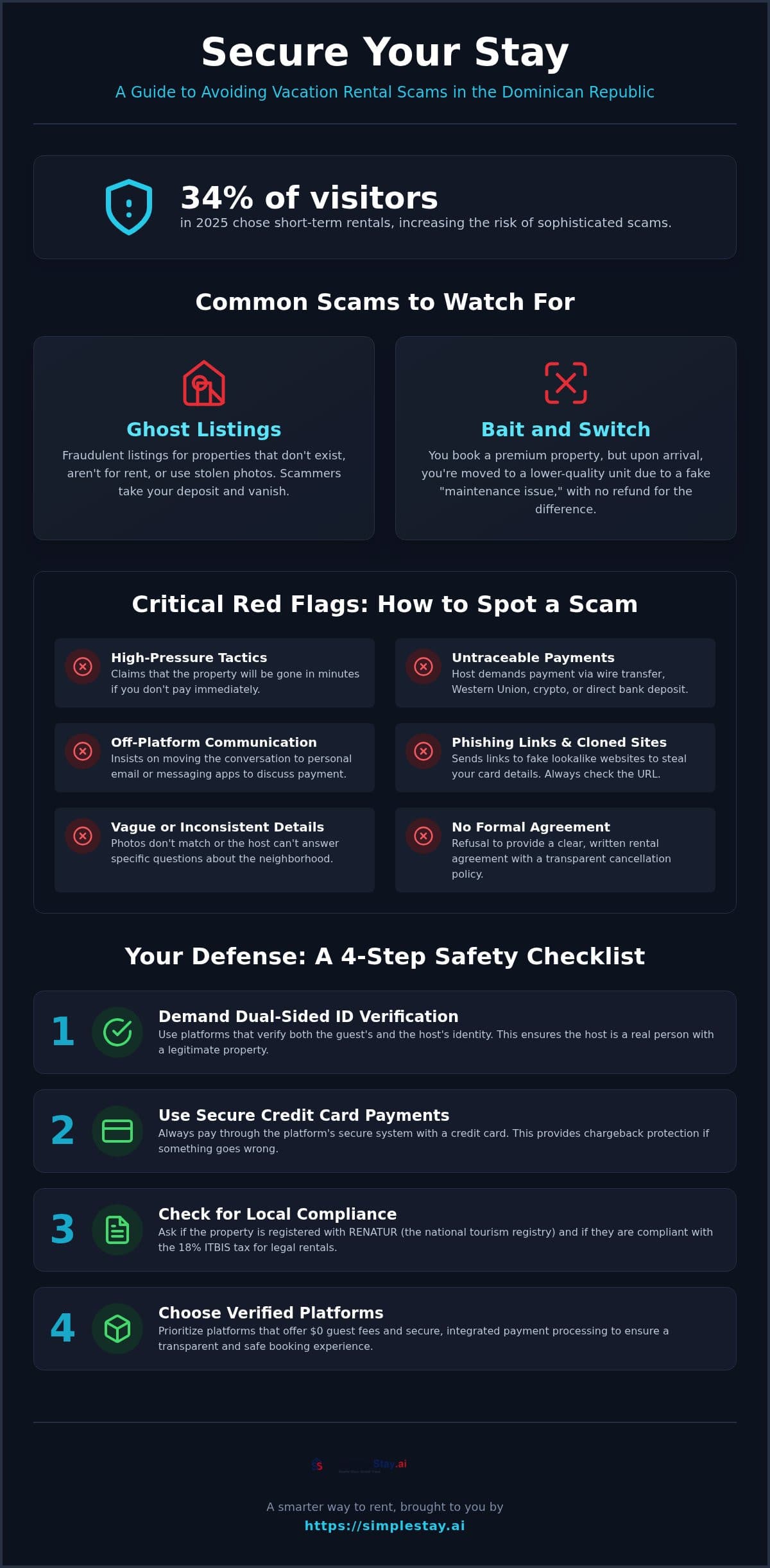
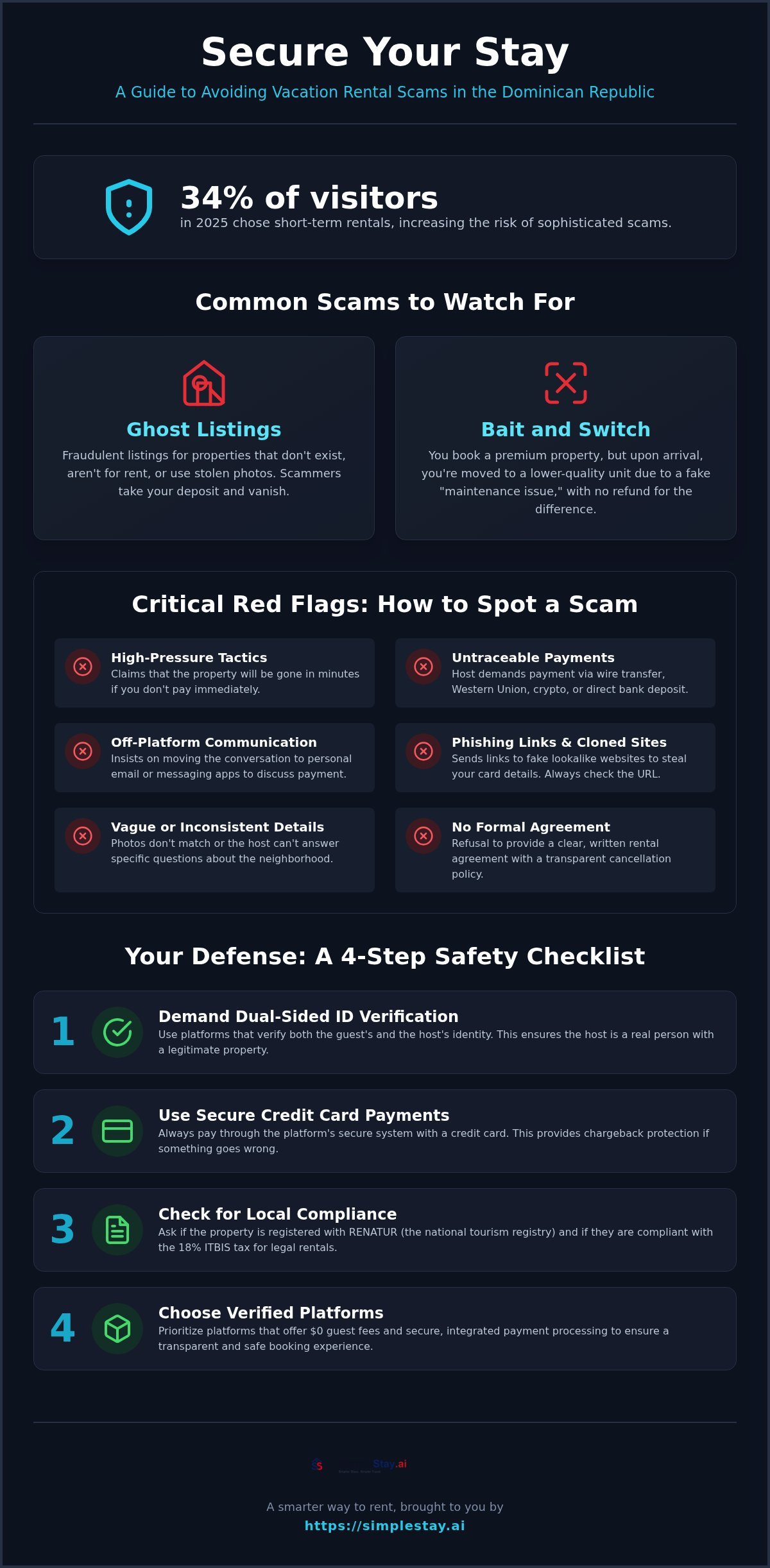
The Dominican Republic is a premier destination for travelers seeking sun and sand. In 2025, the Central Bank reported that 34% of all visitors stayed in short-term rental accommodations. This massive demand has created a fertile ground for sophisticated vacation rental scams. Most fraudulent activities fall into two main categories: ghost listings and the bait and switch.
Ghost listings involve properties that simply do not exist or are not actually for rent. Scammers often steal photos from high-end real estate listings or luxury resorts to create a fake profile. They offer these properties at competitive prices to lure in unsuspecting travelers. Once you send a deposit, the contact person vanishes. The bait and switch is equally frustrating. You book a luxury villa with specific amenities, but upon arrival, the host claims there is a sudden maintenance issue. They move you to a much lower-quality unit while refusing to refund the price difference. Understanding these tactics is essential for anyone learning how to avoid vacation rental scams in Dominican Republic.
The Rise of Social Media Marketplace Fraud
Scammers increasingly use social media travel groups and marketplaces to find victims. They post stunning photos of villas and offer "direct booking" discounts to avoid platform fees. This approach is a major red flag. These listings lack any form of host identity verification. Scammers often pressure you to act quickly by claiming other guests are interested. They typically demand payment through untraceable methods like wire transfers, Western Union, or even cryptocurrency. If a beachfront property in a high-demand area has a price that seems too good to be true, it is likely a scam. Real owners in the Dominican Republic are now beginning to comply with the proposed RENATUR registry to prove their legitimacy, so always ask for official registration details.
Cloned Platforms and Phishing Links
Phishing is a highly effective tool for modern scammers. You might receive a professional-looking email or a link in a chat that appears to lead to a major booking site. These cloned websites are designed to steal your credit card information and personal data. Always inspect the URL carefully before clicking. Scammers use subtle misspellings or unusual domain extensions to mimic official sites. They also try to move the conversation off-platform as soon as possible. This tactic allows them to bypass the security filters and payment protections that legitimate platforms provide. Check for the "https" prefix and a padlock icon in your browser address bar. If a host insists on communicating only via private messaging apps to discuss payment, stop the transaction immediately.
Critical Red Flags: How to Spot a Dominican Republic Rental Scam
Identifying a scam starts with recognizing high-pressure tactics. Fraudsters often create a false sense of urgency, claiming a villa will be gone in minutes if you don't pay immediately. This is a classic hallmark of how to avoid vacation rental scams in Dominican Republic. If you notice inconsistent photos across different platforms, such as a bathroom that clearly belongs to a different house style, walk away. Legitimate hosts provide a clear, written rental agreement and a transparent cancellation policy before asking for any commitment.
Payment Method Warning Signs
Scammers love untraceable money. They will often steer you away from platform-protected payments toward wire transfers, Western Union, or cryptocurrency. These methods offer zero consumer protection. While many local businesses historically operated on cash, modern, secure platforms are changing that. According to official travel advisories, travelers should be wary of credit card and debit fraud in the region. If a host sends you a suspicious third-party link that isn't part of a recognized booking system, it's a major red flag. Legitimate operations in the DR are moving toward secure credit card processing because it builds trust and protects both parties.
Communication Discrepancies
Pay attention to how the host answers your questions. A real host knows the neighborhood. They can tell you where the nearest supermarket is or which beach has the best sunset views. If their answers are vague or sound like they're reading from a brochure, be careful. Scammers often use unencrypted personal messaging apps to move the conversation away from the eyes of security teams. They do this to avoid filters that flag suspicious keywords. Always cross-reference a host’s profile. If they have no history, no reviews, or their account was created yesterday, proceed with extreme caution. Professional hosts who value security often use identity verification platforms to prove they are who they say they are.
Facebook Marketplace and travel groups are hotspots for unverified listings. You'll see stunning villas at half the market price. Scammers in these groups often use stolen photos from legitimate resorts. They rely on the "social proof" of a group setting to make you feel safe. Don't be fooled by a friendly profile picture or a long post in a travel group. Without a formal verification system, you're essentially handing money to a stranger on the internet. In 2026, as the proposed RENATUR registry becomes a standard, you should feel comfortable asking for a host's tax ID (RNC) or registration status as part of your vetting process.
The Role of Identity Verification in Secure Bookings
Trust in the Caribbean rental market shouldn't be a gamble. While traditional platforms often rely on automated filters that scammers can bypass, modern security focuses on dual-sided identity verification. This process requires both the traveler and the host to prove their legal identity before a transaction even begins. It effectively closes the door on anonymous fraudsters who rely on the shadows of the internet to operate. By ensuring every participant is a real person, platforms can eliminate the primary source of ghost listings and payment fraud.
A verified listing is vastly different from an unverified social media post. On platforms like Facebook, anyone can upload stolen photos and claim to own a luxury villa. There is no accountability and no way to track the individual once the money is sent. In contrast, a verified booking ecosystem creates a digital trust profile for every user. This profile acts as a shield, ensuring that the person collecting your payment is the actual owner or authorized manager of the property. Understanding this technology is a foundational step in how to avoid vacation rental scams in Dominican Republic.
What to Look for in a Trusted Rental Platform
Trusted platforms go beyond simple email confirmation. They require a government-issued ID that matches the property owner's legal records. This aligns with the Dominican Republic’s push for formalization through the proposed RENATUR registry, which seeks to document all legitimate short-term rentals. A secure platform will also offer transparent, flat-fee pricing rather than hiding costs in high commissions. This transparency reduces the incentive for hosts to move conversations off-platform, which is where most scams occur. For a deeper look at these safety standards, read our guide on Vacation Rental Identity Verification: The 2026 Guide to Secure Bookings.
Simple Stay ai inc’s Approach to Guest and Host Safety
Simple Stay ai inc prioritizes verification to eliminate friction and fear for both parties. We understand that guests want total transparency, which is why we offer zero platform booking fees. This doesn't mean we cut corners on safety. By charging hosts a flat monthly subscription of $50 rather than taking a percentage of every booking, we focus our resources on rigorous identity checks rather than volume. You aren't just booking an apartment; you're staying with a verified host who has a professional stake in their reputation. This model modernizes the market, replacing risky, anonymous cash transactions with a secure, digital ecosystem that protects your getaway from start to finish.
Safe Payment Strategies for Caribbean Vacation Rentals
The Dominican Republic has traditionally been a cash-heavy market. Travelers often feel pressured to use wire transfers or direct bank deposits to secure a villa. This is a significant risk. Once you send a wire transfer, the money is gone. There's no way to recover it if the property doesn't exist. Digital payments are the most effective tool for how to avoid vacation rental scams in Dominican Republic. They create a paper trail that protects your investment and holds the host accountable.
Why Credit Cards are the Gold Standard for Safety
Credit cards offer a layer of protection that cash and bank transfers can't match. If you arrive and find a "ghost listing," you can initiate a chargeback with your bank. This financial safety net is essential for international travel. Simple Stay ai inc modernizes the Dominican market by moving away from risky cash payments toward secure digital processing. It's important to distinguish between platform booking fees and third-party processing costs. While we offer 0% guest platform fees, your bank or payment processor may still apply standard transaction charges. You can learn more about these savings in our guide on Zero Booking Fee Vacation Rentals: How to Save 20% on Your Next Stay.
Documenting Your Transaction
Always save your digital receipts and booking confirmations the moment you pay. These documents are your primary evidence if a dispute arises. Professional platforms ensure that payouts are handled through secure systems covering 122 countries, which ensures international host reliability. If a host asks for "extra fees" via a private link or cash outside the platform, stop immediately. These requests are often attempts to bypass security filters and steal additional funds. Legitimate costs, such as the 18% ITBIS tax for furnished tourism accommodations, should be clearly detailed within the platform's price breakdown. Keeping all financial interactions within a secure, encrypted environment is the only way to guarantee your protection.
What to Do if You Suspect a Scam or Experience Fraud
If you find yourself staring at a locked gate or a non-existent villa, don't panic. Immediate action is your best tool for recovery. First, contact your bank or credit card issuer to report the fraud. If you followed the advice in previous sections and used a credit card, you can initiate a chargeback process to reclaim your funds. Documenting exactly what happened is vital. This is a critical part of how to avoid vacation rental scams in Dominican Republic because it creates a financial barrier for the scammer and starts the recovery process.
Reporting Fraud to International and Local Bodies
You should report the incident to the booking platform and local authorities immediately. In the Dominican Republic, the Ministry of Tourism (MITUR) is the primary body overseeing the rental market. Provide them with a complete digital trail. This includes screenshots of the listing, all email threads, and your payment records. Reporting cybercrime to national authorities helps improve security for everyone. It ensures that fraudulent hosts are removed from the market and that unverified listings don't claim more victims. Tax and rental regulations can change and vary by jurisdiction, so you should consult with a qualified local attorney or accountant for professional advice specific to your situation.
Finding Emergency Verified Accommodation
Being stranded in a foreign country is a traveler's worst nightmare. If your original booking fails, you need a safe alternative fast. Don't turn back to unverified social media groups in a moment of desperation. Instead, use platforms that prioritize identity verification for both guests and hosts. This ensures that the next property you book actually exists and is managed by a professional. Verified hotels and villas are your safest bet for last-minute stays because they have a physical presence and a reputation to maintain. These stays offer the transparency you need when you're feeling vulnerable after a scam.
Share your experience in travel forums and review sites once you're safe. By naming the fraudulent listing and describing their tactics, you protect the next person from making the same mistake. Alerting the community is a selfless act that strengthens the travel ecosystem. It turns a bad experience into a learning opportunity for others. Your report could be the reason another traveler decides to choose a verified stay instead of a ghost listing.
Explore verified, scam-free vacation rentals in the Dominican Republic.
Plan Your Stay with Absolute Confidence
Your getaway should be defined by the sound of the ocean, not the stress of a potential fraud. We have covered the technical red flags and the legal shift toward the RENATUR registry. Understanding how to avoid vacation rental scams in Dominican Republic empowers you to make informed decisions and ignore the "too good to be true" offers found on unverified social channels. Safety is a choice, and you now have the knowledge to choose wisely.
Simple Stay ai inc was built to eliminate these risks through a transparent, flat-fee model. By focusing on rigorous identity verification for both guests and hosts, we remove the anonymity that scammers rely on. You can secure your reservation knowing that our platform prioritizes your peace of mind with secure credit card processing and $0 guest service fees. We focus on modernizing the rental market so you can focus on your vacation.
The tools for a safe and seamless Caribbean experience are now in your hands. Take the next step toward a worry-free vacation and start exploring verified properties today. You deserve a stay that is as transparent as the turquoise waters waiting for you. Enjoy the beauty of the island with total confidence.
Frequently Asked Questions
Is it safe to book a vacation rental in the Dominican Republic through Facebook?
Booking through Facebook is generally unsafe because the platform lacks host identity verification and property ownership checks. Scammers frequently use stolen photos from luxury resorts to create fake listings in travel groups. Without a secure payment system, you have no protection if the property doesn't exist upon arrival. It's better to use platforms that require government ID and offer secure digital processing to ensure your money and vacation are protected.
What is the safest way to pay for a rental in the Caribbean?
The safest way to pay is via a credit or debit card through a secure, encrypted platform. Credit cards offer built-in fraud protection and the ability to initiate a chargeback if you discover a ghost listing. Avoid any host who insists on cash, wire transfers, or cryptocurrency. These methods are untraceable and offer no consumer recourse. Using a digital payment system creates a permanent record of the transaction for your safety.
How can I verify if a Dominican Republic villa listing is real?
You can verify a listing by asking the host for their RENATUR registration number or their tax ID (RNC). Perform a reverse image search on the property photos to see if they appear on other websites with different contact details. Check for a consistent history of reviews across multiple years. Legitimate hosts will be happy to provide specific local details about the neighborhood that a scammer simply wouldn't know.
Should I ever pay for a vacation rental via wire transfer?
You should never pay for a rental via wire transfer, Western Union, or direct bank deposit to an individual. These payment methods are equivalent to sending cash in an envelope; once the money is sent, it cannot be recovered. Scammers often use these methods because they bypass the security filters of legitimate booking platforms. If a host pressures you for a wire transfer to save on fees, it is a major red flag.
What are the most common red flags in a rental listing?
Common red flags include prices that are significantly lower than the local market average and hosts who create a false sense of urgency. Watch out for listings with inconsistent photos or vague descriptions that don't match the location. Another warning sign is a host who immediately asks to move the conversation to a private messaging app. Learning how to avoid vacation rental scams in Dominican Republic involves recognizing these patterns before sending any payment.
What should I do if the host asks to move the conversation to WhatsApp?
You should decline and insist on keeping all communication within the booking platform. Scammers move to WhatsApp to avoid the automated security filters that flag fraudulent keywords and suspicious links. By staying on the platform, you maintain a documented record of all promises made by the host. This documentation is essential if you need to report a problem or request a refund from the platform's support team later in the process.
Does travel insurance protect me against vacation rental scams?
Travel insurance typically covers trip cancellations or medical emergencies rather than direct financial fraud from a scammer. While some high-end policies offer identity theft or travel fraud protection, they often require a police report and have strict limitations. The best defense is prevention through secure payment methods and identity verification. Don't rely on insurance to recover money sent via untraceable wire transfers; prioritize booking through verified, secure platforms instead.
How does identity verification prevent scams on booking platforms?
Identity verification prevents scams by requiring hosts to upload government-issued identification that is cross-referenced with real-world records. This removes the anonymity that scammers need to operate ghost listings. When both guests and hosts are verified, it creates a transparent ecosystem where everyone has a professional stake in their reputation. This technological layer is a key part of how to avoid vacation rental scams in Dominican Republic by ensuring every user is a real person.

Article by
Jaime Robledo, MBA
Jaime Robledo, MBA, is a technology leader, entrepreneur, and founder based in Santo Domingo, Dominican Republic, with more than two decades of experience building, modernizing, and securing enterprise technology environments. His career has spanned consulting, media, finance, education, healthcare, and large-scale corporate IT, with deep expertise in Microsoft technologies, cloud infrastructure, endpoint management, automation, cybersecurity, AI, and digital transformation.
Throughout his career, Jaime has led complex technical initiatives involving Microsoft Intune, Microsoft 365, Defender, SCCM, Azure, PowerShell, DevOps, Windows modernization, and enterprise infrastructure. His experience combines hands-on engineering, technical leadership, business strategy, and execution.
Today, Jaime is focused on building technology companies designed specifically for Latin America. He is the founder of SimpleStay.ai, a rental and hospitality platform created to make booking, hosting, rent payments, and property management more transparent and affordable through flat pricing, zero guest service fees, secure payments, identity verification, and support for short-term, hotel, and long-term rentals.
He also built United Empresas, a marketplace connecting customers with local service professionals for discovery, booking, payments, and business growth.
Beginning in January, Jaime will also be building a new fintech platform in public, focused on making digital payments and money movement simpler and more accessible across Latin America.
Across every venture, Jaime’s mission is the same: use technology, AI, automation, and practical business systems to reduce friction, create jobs, strengthen small businesses, expand financial access, and improve people’s lives throughout Latin America.