Published September 21, 2026
How to Avoid Booking Scams in the Caribbean: 2026 Safety Guide
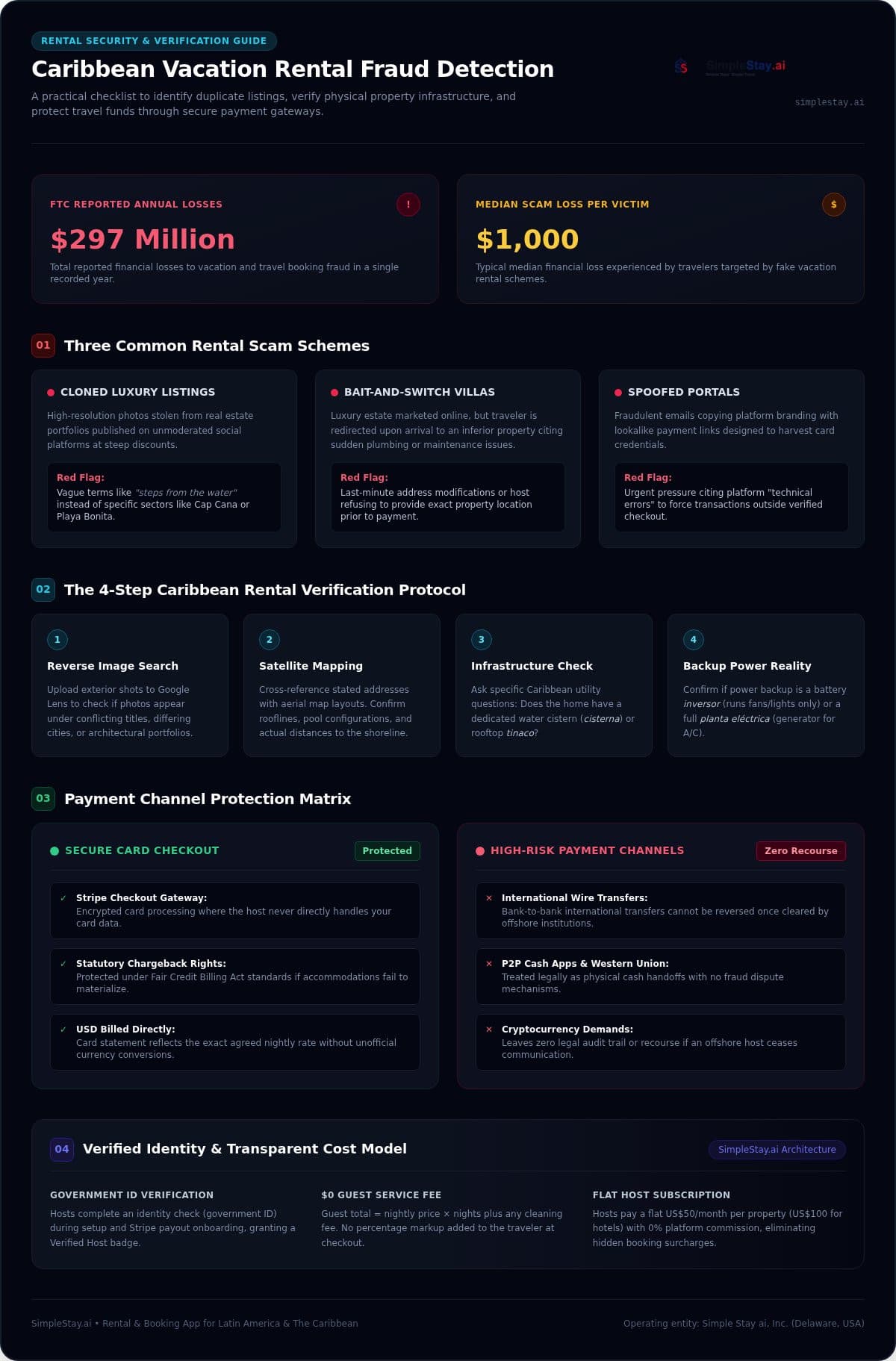
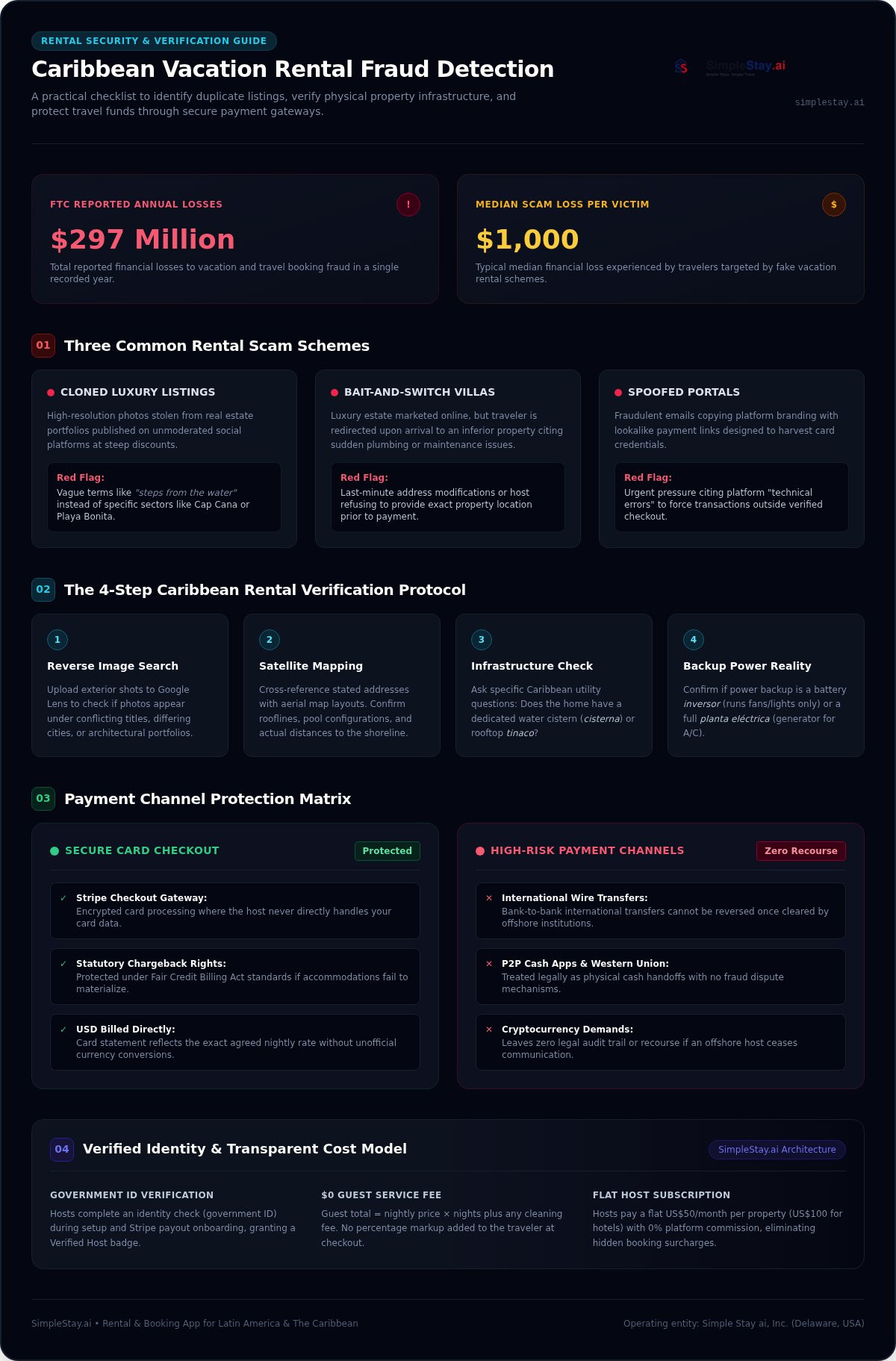
According to the Federal Trade Commission, travelers lost nearly $297 million to vacation and booking fraud in a single year, with rental scam victims reporting a median loss of $1,000. When you are planning a tropical getaway, the last thing you want is the dread of wiring money across borders for an address that turns out to be an empty lot. Knowing how to avoid booking scams in the Caribbean starts with understanding that safety comes from secure payment architecture and verified host identities, not high marketplace markups.
You shouldn't have to guess whether a host actually owns the beachfront apartment they posted online. In this guide, you'll learn how to spot cloned listings quickly, verify properties across international borders before committing, and use secure card checkout that preserves your statutory chargeback rights. Here is your practical roadmap to identifying common rental traps, confirming host identities, and keeping your hard-earned travel budget safe.
Key Takeaways
- Spot duplicate photo schemes and unrealistic discounts before you message an unverified host.
- Master how to avoid booking scams in the Caribbean by verifying street addresses, checking satellite layouts, and asking about local essentials like backup power systems.
- Protect your travel funds by paying strictly through encrypted card processors like Stripe Checkout to preserve your credit card chargeback rights.
- Choose platforms where hosts complete government ID checks and display transparent pricing without hidden service fees.
Table of Contents
Common Caribbean Vacation Rental Scams and Warning Signs
Vacation rental scams across popular Caribbean destinations follow predictable mechanics. Understanding these patterns is essential when learning how to avoid booking scams in the Caribbean before you send a deposit. In a bait-and-switch villa scam, an operator markets a pristine luxury estate online but directs you upon arrival to a degraded, alternate property citing sudden plumbing or maintenance emergencies. Scammers also send spoofed emails that copy major platform branding to harvest your card details through lookalike payment portals.
Fake Luxury Villa Listings on Social Media
Unmoderated classifieds on Facebook Marketplace and Instagram are prime hunting grounds for scammers. Fraudsters steal high-resolution photos from real estate sales or architectural portfolios in destinations like Punta Cana and Las Terrenas, republishing them at deep discounts. You can spot these cloned listings by their vague geographic descriptions. Legitimate hosts specify the exact sector or gated community, such as Cap Cana or Playa Bonita, while scammers rely on generic phrases like "steps from the water" to avoid scrutiny.
High-Pressure Off-Platform Payment Requests
The clearest warning sign of rental fraud is an urgent push to leave secure booking channels. Fraudulent operators invent platform technical errors or claim another guest is holding the calendar, creating artificial panic. They direct you to finalize the reservation using methods that offer zero chargeback protection:
- Direct wire transfers: Bank-to-bank transfers across international borders cannot be reversed once processed.
- Cash transfer apps: Peer-to-peer services and Western Union treat transactions like physical cash handoffs.
- Cryptocurrency demands: Requests for digital assets leave no legal audit trail if the listing does not exist.
Knowing how to avoid booking scams in the Caribbean requires walking away the moment a host refuses transparent, on-platform card checkout.
How to Verify a Caribbean Rental Property and Host
Protecting your reservation requires a proactive screening routine before you enter card details. Learning how to avoid booking scams in the Caribbean means looking past glossy photos and validating the physical reality of the listing. Cross-checking key property features and confirming identity credentials establishes clear accountability before you book.
Digital Image and Map Verification Steps
Start by uploading listing exterior shots to Google Lens. Cloned properties often appear under conflicting titles in multiple destinations. Next, pull up the property's stated location on satellite mapping tools. Check whether the roofline, pool layout, and shoreline distance match the listing's claims. When booking in the Dominican Republic, ask specific questions about essential regional infrastructure: does the property have a dedicated cisterna (water cistern) or rooftop tinaco, and what backup power is installed? Legitimate hosts readily explain whether they rely on a battery inversor for basic fans or a full planta eléctrica (generator) to run air conditioning during localized utility outages.
Confirming Host Identity and Badges
Never rely on unmoderated social media profiles, which anyone can fabricate in minutes. Prioritize platforms that require hosts to submit official government identification documents during account setup. You can read our guide on vacation rental identity verification to understand how identity checks screen listing creators. On reliable booking platforms, look for an identity-verified host badge indicating that the operator's legal credentials have been checked against official records.
Confirming an operator's real-world identity gives you clear recourse if issues arise. Property managers who value complete transparency and want to build direct trust with travelers can sign up as a host to establish verified credentials and manage bookings cleanly.
Secure Payment Practices for Caribbean Stays
Your payment method represents your final line of defense against booking fraud. Knowing how to avoid booking scams in the Caribbean requires selecting billing channels that preserve your legal protections if a property fails to materialize.
Credit Card Protections vs. Wire Transfers
Always pay by card through an encrypted gateway like Stripe Checkout. Under statutory cardholder rules, including the Fair Credit Billing Act, credit cards grant dispute mechanisms when a host fails to deliver promised accommodations. Wire transfers, Cash App, and cryptocurrency operate like physical cash handoffs across borders. Once funds clear an offshore account, your financial institution cannot reverse the transfer. Check that your card checkout bills directly in US dollars so your bank statements reflect the exact agreed rate.
Keeping Communications on Official Channels
Scammers regularly try shifting discussions to WhatsApp, SMS, or private email. They do this to evade platform monitoring and delete paper trails. If a host claims their platform messaging is broken or insists on sending a separate invoice link via text, stop immediately. Keeping every message inside the official inbox provides an immutable, timestamped record of check-in terms and host commitments. Fair fee models also remove the temptation to step off-platform. Check our breakdown on zero booking fee vacation rentals to see how transparent pricing protects your travel funds.
Staying entirely on-platform with card checkout remains the most reliable rule for how to avoid booking scams in the Caribbean.
Safe Booking Solutions and Host Best Practices
Safe accommodations depend on transparent booking mechanics rather than marketplace markups. Travelers seeking how to avoid booking scams in the Caribbean benefit most when identity validation occurs before a property ever goes live. Legitimate vacation rentals and boutique hotels outline explicit house rules, check-in windows, and neighborhood safety guidelines right on the listing page. For extended 3, 6, or 12-month stays, reputable hosts use formal rental requests instead of demanding informal cash deposits through chat apps.
What to Do If You Suspect a Rental Scam
Act immediately if you realize a transaction is fraudulent. Contact your credit card issuer to dispute the charge under merchant non-delivery protections. Assemble full documentation, including listing screenshots, inbox messages, payment receipts, and property addresses. If you encounter an incident on Dominican soil, contact POLITUR (the tourist police) nationwide at 911 or via their central line at +1 809-200-3500 for bilingual assistance. When booking your next stay, review our complete guide on Dominican Republic apartment rentals to choose established residential areas.
How Modern Platforms Safeguard Caribbean Rentals
Modern platforms remove scam incentives by eliminating heavy marketplace markups that drive guests off-platform. SimpleStay requires hosts to complete a government ID check powered by Stripe Identity before receiving an identity-verified badge. Guests complete card transactions through Stripe Checkout in USD with a $0 guest service fee, ensuring you pay the host's actual nightly rate. Hosts pay a flat $50 monthly subscription for standard rentals ($100 for hotels) with 0% booking commission, which eliminates fee evasion tactics. If you manage an apartment or villa, you can establish an authenticated profile and register as a verified host to provide secure, direct bookings for Caribbean travelers.
Protect Your Next Caribbean Getaway
Planning an island escape should bring excitement, not anxiety over phantom addresses or lost travel funds. Successfully mastering how to avoid booking scams in the Caribbean comes down to a few disciplined verification habits. Always confirm that property photos and layouts match real satellite maps, look for hosts who have completed formal government ID checks, and immediately reject any request to shift conversations or money off-platform.
Insisting on encrypted card checkout preserves your statutory chargeback protections if an accommodation fails to match its description. Modern platforms that pair identity-verified hosts with zero guest service fees remove the financial friction that scammers exploit. Both travelers and property managers benefit when hospitality operates on complete transparency.
Take these safety steps before sending payment, and enjoy your Caribbean retreat with complete peace of mind.
Frequently Asked Questions
What is the most common vacation rental scam in the Caribbean?
The most frequent scheme involves cloned listings published on open social media classifieds. Scammers steal photos from legitimate real estate sales or luxury villas in Punta Cana and Las Terrenas, then advertise deeply discounted rates. They pressure travelers to send irreversible deposits before vanishing. Learning how to avoid booking scams in the Caribbean begins with refusing unverified social ads and prices that look too good to be true.
Is it safe to pay a Caribbean vacation rental host through PayPal or wire transfer?
No, you shouldn't pay hosts using wire transfers, peer-to-peer mobile apps, cash, or personal transfer links. These payment methods eliminate your legal chargeback rights if an accommodation turns out to be fake. Platforms like SimpleStay process reservations exclusively through Stripe Checkout in USD, preserving federal cardholder protections while routing host payouts securely through compliant bank transfers.
How can I check if a rental villa in the Dominican Republic actually exists?
Run listing exterior photos through reverse image searches and cross-reference coordinates on satellite mapping services. Confirm that the perimeter, pool design, and street access match the marketing photos. When renting in Santo Domingo, Santiago, or Puerto Plata, ask whether the home includes an inversor or planta eléctrica for backup power and a dedicated water cisterna. Scammers rarely know these local utility specifics.
What should I do if a host asks to communicate exclusively on WhatsApp?
Decline the request and insist on keeping all messaging inside the platform's official system. Fraudulent operators push travelers off-platform to avoid automated fraud monitors and erase communication paper trails. A key principle for how to avoid booking scams in the Caribbean is maintaining timestamped records of all check-in arrangements, house rules, and pricing confirmations within your official inbox.
Can I get my money back if I fall victim to a Caribbean rental scam?
Your ability to recover funds depends on the transaction method you used. If you paid by credit card through an encrypted payment processor, you can file a chargeback claim under statutory billing protection laws for unrendered services. If you sent money via international wire transfer, money orders, cash apps, or cryptocurrency, financial institutions generally cannot reverse the transaction once funds leave your account.

Article by
Jaime Robledo, MBA
Jaime Robledo, MBA, is a technology leader, entrepreneur, and founder based in Santo Domingo, Dominican Republic, with more than two decades of experience building, modernizing, and securing enterprise technology environments. His career has spanned consulting, media, finance, education, healthcare, and large-scale corporate IT, with deep expertise in Microsoft technologies, cloud infrastructure, endpoint management, automation, cybersecurity, AI, and digital transformation.
Throughout his career, Jaime has led complex technical initiatives involving Microsoft Intune, Microsoft 365, Defender, SCCM, Azure, PowerShell, DevOps, Windows modernization, and enterprise infrastructure. His experience combines hands-on engineering, technical leadership, business strategy, and execution.
Today, Jaime is focused on building technology companies designed specifically for Latin America. He is the founder of SimpleStay.ai, a rental and hospitality platform created to make booking, hosting, rent payments, and property management more transparent and affordable through flat pricing, zero guest service fees, secure payments, identity verification, and support for short-term, hotel, and long-term rentals.
He also built United Empresas, a marketplace connecting customers with local service professionals for discovery, booking, payments, and business growth.
Beginning in January, Jaime will also be building a new fintech platform in public, focused on making digital payments and money movement simpler and more accessible across Latin America.
Across every venture, Jaime’s mission is the same: use technology, AI, automation, and practical business systems to reduce friction, create jobs, strengthen small businesses, expand financial access, and improve people’s lives throughout Latin America.