Published August 11, 2026
Booking.com vs Airbnb Dominican Republic: The 2026 Comparison Guide

What if the service fee you see at checkout is actually the smallest part of the markup you're paying for your Caribbean getaway? Navigating the options for your Dominican Republic stay, particularly when considering Booking.com and other popular rental platforms, used to be a simple matter of preference. However, in 2026, the landscape has shifted significantly. Between rising platform commissions and the Dominican Republic's new RENATUR registry requirements, finding a fair deal now requires looking past the glossy photos. You deserve a transparent booking process where the price you see is the price you actually pay, without hidden markups eating into your travel budget or your rental profits.
It's frustrating to watch a great nightly rate balloon with extra charges or to worry if a property is truly verified under the latest local laws. This guide uncovers the real differences in fees, safety, and reliability between the top platforms in the Dominican Republic. You'll learn how to avoid the 20% commission trap, ensure your stay is fully compliant with Ministry of Tourism regulations, and discover why the future of Caribbean rentals is moving toward flat-fee local ecosystems like Simple Stay ai inc. We'll compare the heavyweights head-to-head so you can book or host with total confidence and peace of mind.
Key Takeaways
- Understand how the new 15.5% host-only fee structure and Booking.com’s variable commissions impact your total cost in the Dominican market.
- Navigate the 2026 RENATUR regulations to ensure your property or stay remains fully compliant with the Ministry of Tourism’s new mandatory registry.
- Evaluate Booking.com vs Airbnb Dominican Republic to see which platform offers the best balance of identity verification and payout reliability for local bank accounts.
- Identify the "checkout shock" tactics platforms use and how to find listings that offer true price transparency from the first click.
- Explore the transition from high-commission models to flat-fee subscriptions that allow hosts to keep their full earnings while guests pay zero service fees.
Table of Contents
The Dominican Republic Rental Landscape: Airbnb vs. Booking.com in 2026
The Dominican Republic has solidified its position as a significant hub for short-term rentals. In 2025, data indicated that a substantial portion of visitors chose private accommodations over traditional hotels. This significant shift has made the region a competitive battleground for global platforms. Understanding the nuances of Booking.com vs Airbnb Dominican Republic is essential for anyone looking to maximize their stay or their profits. The trends observed here reflect broader challenges and opportunities for property owners and guests worldwide, as platforms facilitating these stays evolve in ways that don't always benefit local markets.
Hosts and guests are currently experiencing "commission fatigue." With major platforms increasing their take from every booking, the financial burden has become a significant hurdle for property owners. This environment has paved the way for more transparent solutions like Simple Stay ai inc that prioritize identity verification over high profit margins. The market is no longer just about who has the most listings. It's about who offers the most security and the lowest friction for the user.
Market Dominance and Property Variety
The DR landscape offers a diverse mix of property types. In popular coastal areas, high-end villas often dominate the market. In contrast, major urban centers frequently see a surge in modern apartment rentals. Professional property management has become the standard in these competitive markets. Most managers now cross-list their units on multiple platforms to ensure visibility. This strategy works for occupancy. However, it forces hosts to manage different fee structures and cancellation policies, which often leads to pricing confusion for the guest. When comparing Booking.com vs Airbnb Dominican Republic, you'll find that while the properties are often the same, the final price rarely is.
Guest Demographics and Stay Patterns
Different platforms attract distinct traveler profiles in the DR. Airbnb is often the preferred choice for digital nomads and long-term guests who value kitchen facilities and a "home" feel. These travelers often stay for weeks and look for monthly discounts. Booking.com typically captures the weekend traveler or the international tourist who is more comfortable with a hotel-style interface. Both platforms are now facing pressure from increasing regulatory oversight. This trend, exemplified by new requirements for official registration of listings, is adding new layers of compliance for hosts across various markets. Disclaimer: Requirements for taxes, contracts, and regulations vary by jurisdiction. Readers should consult with professional legal or tax advisors to ensure full compliance with applicable laws.
Comparing Guest Fees and Pricing Transparency
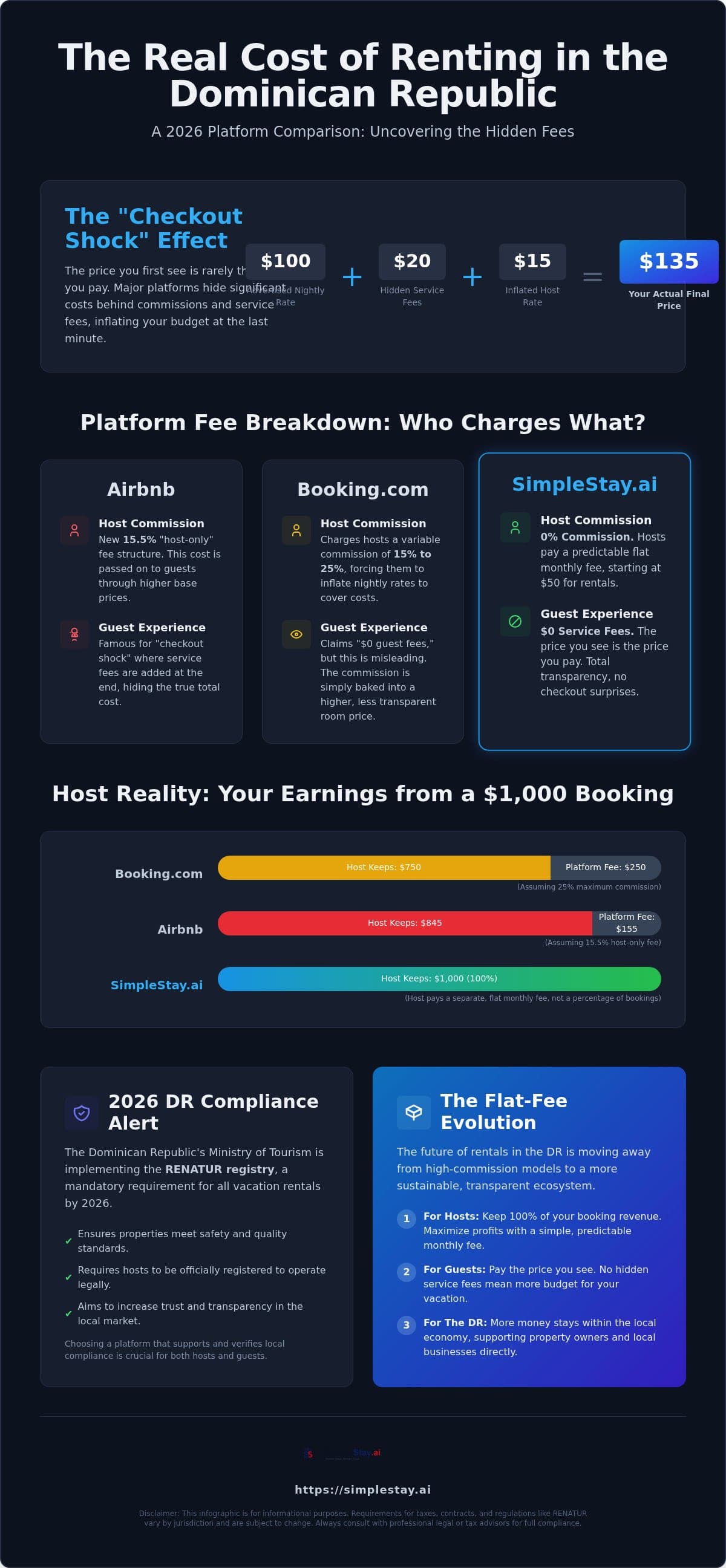
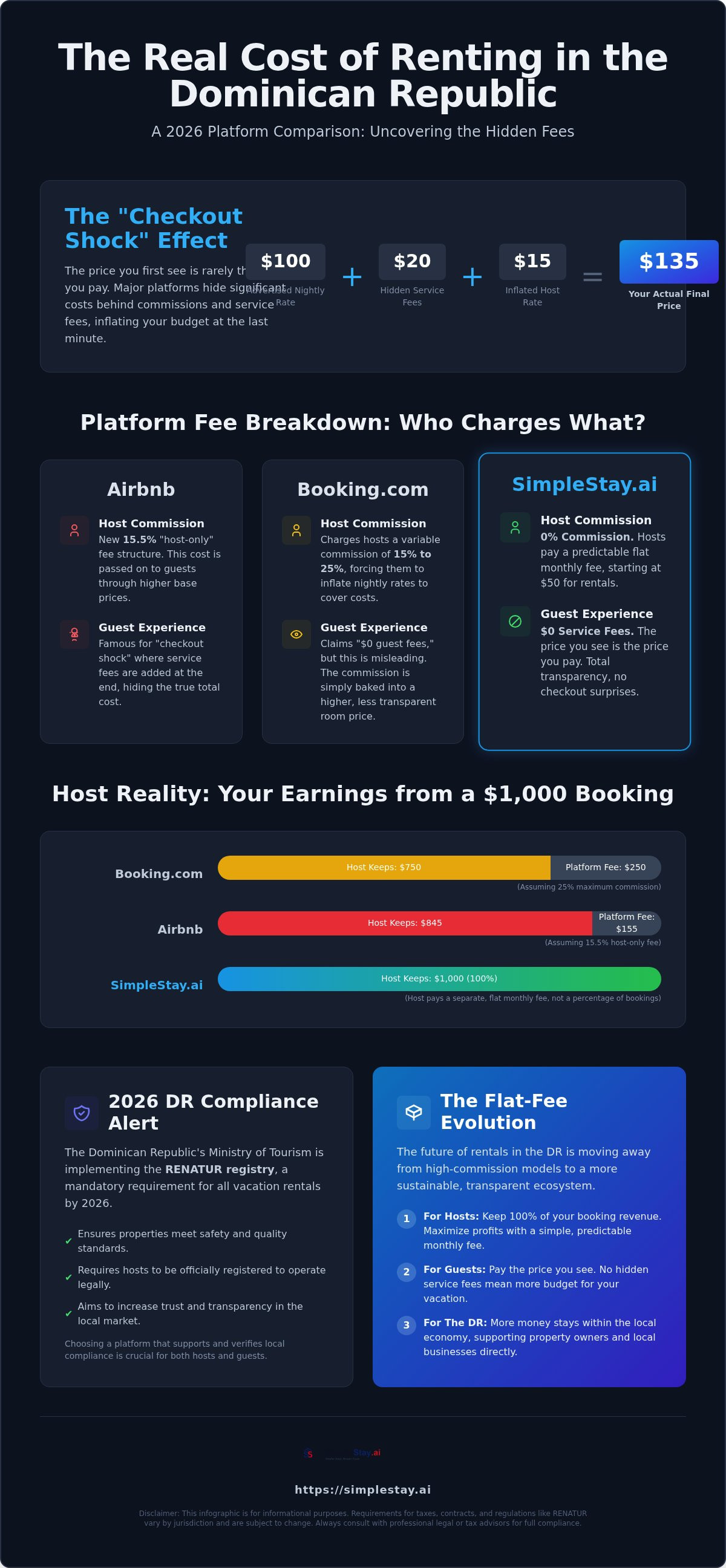
Transparency is the first casualty in the battle of Booking.com vs Airbnb Dominican Republic. For guests, the "checkout shock" on Airbnb is a well-known frustration. You find a villa in Las Terrenas for a specific price, only to see it climb significantly once service fees and occupancy taxes are added. While Airbnb is moving toward a host-only fee model to make the initial price appear more "all-inclusive," that cost hasn't disappeared; it's simply shifted from a visible line item to a higher base rate. Booking.com takes the opposite approach by claiming zero guest fees. However, because they charge hosts commissions that can reach 25%, property owners are forced to inflate their nightly rates to protect their margins.
Beyond platform fees, local tax implications like the ITBIS (Value Added Tax) on digital services can catch travelers off guard. These charges are often calculated at the final booking stage, significantly altering the total budget. Currency conversion traps are another subtle drain on resources. If a platform lists a property in USD but processes the transaction in DOP, or applies an unfavorable exchange rate, guests can lose an additional 3% to 5%. These inefficiencies in the tourism industry's link to poverty alleviation show how global fees often pull money away from local economies and the pockets of travelers.
Disclaimer: Tax requirements, digital service regulations, and ITBIS rates vary by jurisdiction and are subject to change. Readers should consult with professional tax or financial advisors regarding specific compliance and obligations in the Dominican Republic.
The True Cost of a $100 Nightly Stay
On a typical $100 nightly listing, the "hidden" markup becomes clear. On Airbnb, that $100 might stay $100 at checkout, but the host has already raised the price from $85 to cover the platform's 15.5% take. On Booking.com, the same room might be listed at $120 to account for their variable commission. Cleaning fees are used differently across platforms as well; Airbnb hosts often use them as a separate line item, while Booking.com properties tend to roll them into the total. On average, guests pay a 15% to 20% markup on the base nightly rate simply to subsidize the platform's commission costs.
Transparent Pricing vs. Tiered Fees
Savvy travelers are increasingly demanding "Zero Booking Fees" to ensure their money reaches the local host directly. High platform fees make long-term stays particularly expensive for digital nomads looking to reside in Santo Domingo or Punta Cana for months at a time. You can learn how to save 20% with zero booking fee rentals by bypassing these tiered structures. If you're a property owner tired of inflating your rates to cover these corporate costs, consider registering your property with Simple Stay ai inc to offer your guests true price transparency.
Host Realities: Commissions, Payouts, and Control
Managing a vacation rental in the DR involves more than just keeping the pool clean. It's about protecting your profit margins from the "Commission Trap." When comparing Booking.com vs Airbnb Dominican Republic from a host's perspective, the numbers are sobering. Airbnb's shift to a mandatory 15.5% host-only fee means that on an average monthly revenue of $1,550, you're handing over roughly $240 every single month. Booking.com can be even more aggressive. Their commissions often reach 25% for properties participating in visibility programs. This isn't just a small fee; it's a significant portion of your income that could be reinvested into your property.
Financial Logistics for Dominican Hosts
Receiving your money shouldn't be a struggle. While global platforms support payouts to 122 countries, Dominican hosts often face delays or high intermediary bank fees for international transfers. It's vital to distinguish between platform fees and payment processing costs. Even if a platform claims a specific percentage, your local bank might take an additional cut for the wire transfer. This financial friction is why many local owners are moving toward subscription-based listing models. A flat monthly fee provides a level of predictability that percentage-based commissions simply can't match. To learn more about optimizing your operations, check out our guide on Mastering BNB Hosting in the Dominican Republic.
Dispute Resolution and Support
Who wins when a guest breaks a house rule or cancels at the last minute? Airbnb provides AirCover, which offers a layer of protection, but getting a claim approved for a property in the DR can be a bureaucratic marathon. Booking.com takes a more hands-off approach. If a guest is a "no-show," the host is often responsible for chasing the payment themselves unless they've opted into platform-managed payment systems. This lack of control over guest screening is a major concern. In the Caribbean market, knowing exactly who is entering your home is a safety requirement. Most hosts find that having the final word on guest verification is the only way to ensure long-term peace of mind. You need a system that allows you to set firm rules and enforce them without platform interference.
Safety and Identity Verification in the Caribbean
Safety is the most important factor when choosing between Booking.com vs Airbnb Dominican Republic. While both platforms offer some level of protection, the reality of the Caribbean market requires a more rigorous approach. Standard verification on global sites often fails because it focuses on digital footprints rather than physical reality. This gap allows for "bait and switch" listings, where a traveler arrives at a luxury villa only to find a property that looks nothing like the photos. To prevent this, both guests and hosts need a system that prioritizes verified identity over high-volume listings.
The Dominican Republic is currently professionalizing its rental sector through the RENATUR registry, but platform-level security still varies. Airbnb requires identity verification for all users, which includes a government ID and a selfie. Booking.com is often more relaxed for guests, requiring only an email and a credit card. This discrepancy can leave local hosts feeling vulnerable. True security in the DR rental market comes from ensuring that every person entering a property has been thoroughly vetted against legal documents.
The Role of Identity Verification
A verified email merely confirms digital access to a mailbox, whereas a verified government ID cross-references a user's biometric data and legal status to confirm their true identity.
This level of scrutiny is essential for building trust, especially for solo travelers and female nomads exploring the DR. When you know a host has been identity-verified, the risk of fraudulent listings or unsafe environments drops significantly. Verification creates a transparent ecosystem where accountability is the standard rather than the exception. You can learn more about these security measures in The 2026 Guide to Vacation Rental Identity Verification.
Ensuring Secure Payments
Moving away from cash-based transactions is the single biggest safety improvement for the Dominican rental market. Many hosts still request "pay at property" or cash payments to avoid platform fees, but this leaves both parties unprotected. Digital rent payments via credit or debit cards provide a secure paper trail and a mechanism for dispute resolution. It's much safer to use a platform that handles the financial logistics and holds funds until the stay is confirmed.
Simple Stay ai inc manages this process by ensuring secure disbursements for property owners while protecting guest data during the entire booking cycle. This modernization of the payment process eliminates the risks associated with carrying large amounts of cash or sharing sensitive banking information over unencrypted chat apps. By combining identity verification with digital payments, the rental experience becomes a professional transaction rather than a risky gamble.
Simple Stay ai inc: The Commission-Free Evolution for the DR
The choice between Booking.com vs Airbnb Dominican Republic usually feels like choosing between two high-cost middlemen. Both take a significant cut from every transaction, making it harder for local hospitality businesses to thrive. Simple Stay ai inc offers a different path by removing commissions entirely. Instead of losing a large portion of your revenue on every booking, property owners pay a fixed monthly subscription. This shift empowers Dominican hosts to keep their full earnings while providing guests with a much fairer price point. It's a model designed to support the local economy rather than draining it through global service fees.
A Better Deal for Hosts and Landlords
Predictability is the foundation of a successful business. When you pay a flat monthly fee of $50 for a rental property, your costs don't increase just because you have a busy season. For hotels, this predictable pricing starts at $100 per month, providing a professional management suite without the commission trap. This model is far superior to variable commissions that penalize your growth. Whether you manage short-term vacation stays or long-term monthly apartments, you can handle everything on one platform. This versatility allows you to adapt to market demands without juggling multiple accounts or fee structures. You keep the full value of every night booked, ensuring your business remains sustainable and profitable.
A Superior Experience for Travelers
Travelers also benefit from this evolution. On major platforms, the prices you see are often inflated to cover corporate fees and hidden markups. Simple Stay ai inc guests pay $0 in platform service fees, meaning your money goes directly to the property rather than a corporate office. You can find verified villas and apartments without the massive markup found on global sites. The platform modernizes the local market by allowing secure digital rent payments via credit and debit cards. This eliminates the need for risky cash handovers and provides a professional experience built specifically for the Caribbean ecosystem. When comparing the long-term value of Booking.com vs Airbnb Dominican Republic, the transition to a dedicated local platform offers a faster, safer, and more honest way to explore the country.
Choosing the Future of Dominican Hospitality
Deciding between Booking.com vs Airbnb Dominican Republic is no longer just about which app has a better map. It's about deciding who controls the value of a stay. As we've explored, the global giants prioritize their own margins through tiered commissions and hidden service charges. Moving toward a more sustainable local market means choosing tools that protect the host's profit while ensuring the guest isn't penalized for booking. This shift toward transparency is essential for the long-term health of the Dominican tourism sector.
Simple Stay ai inc offers the clarity that traditional platforms lack. By providing a flat monthly subscription for hosts, zero booking fees for guests, and mandatory identity verification for all users, the platform removes the friction that has plagued the Caribbean rental market for years. You can now manage your properties or plan your travels without the fear of unexpected costs or unverified participants.
Embrace a modern approach to rentals that puts security and fairness first, ensuring your experience in the Dominican Republic is as seamless as it is profitable.
Frequently Asked Questions
Is Airbnb or Booking.com cheaper for guests in the Dominican Republic?
The final price depends on how the host offsets platform commissions. In the Booking.com vs Airbnb Dominican Republic comparison, Airbnb's 15.5% host fee is usually baked into the nightly rate. Booking.com commissions range from 15% to 25%, often leading to higher base prices. For the best value, look for platforms that eliminate guest service fees entirely, allowing you to pay the true market rate for the property.
What are the common hidden fees when booking a villa in the DR?
Cleaning fees and currency conversion markups are the most frequent surprises. While some platforms show a total price early, others add cleaning costs at the final checkout screen. You should also watch for bank fees if you're paying in a currency different from the listing. Using a platform with transparent pricing ensures the price you see on the search page matches the final amount on your receipt.
How do I verify if a host is legitimate on these platforms?
Check for a verified identity badge and read recent reviews from the last three months. In 2026, legitimate hosts in the DR should also be able to provide their RENATUR registry information from the Ministry of Tourism. Platforms that mandate government ID and biometric verification for every user provide the highest level of security against fraudulent listings and "bait and switch" scams.
Can I pay for my monthly apartment rental with a credit card in the DR?
Yes, digital payments are becoming the standard for long-term stays. While many local landlords traditionally requested cash or bank transfers, modern platforms now facilitate credit and debit card payments for monthly leases. This shift protects your funds through a secure paper trail and allows you to manage your rental budget more efficiently without the risks associated with carrying large amounts of cash.
Which platform has the best cancellation policy for Caribbean travel?
Airbnb offers standardized tiers like Flexible or Firm, while Booking.com policies are set individually by each property owner. Caribbean travel can be unpredictable due to weather or flight changes, so always prioritize listings with at least a 24-hour free cancellation window. Be sure to read the specific fine print section, as local hosts may have different requirements for peak holiday seasons.
What is the benefit of a commission-free rental platform like SimpleStay.ai?
The primary benefit is that hosts keep 100% of their earnings while guests pay zero platform service fees. By replacing high percentage-based commissions with a flat monthly subscription, the platform lowers the total cost of the stay for everyone. This model supports local property owners and ensures that travelers aren't paying a 20% markup just to cover a corporate middleman's profit margins.
Are taxes like ITBIS included in the displayed price on these sites?
Display practices vary by platform and the user's location. Airbnb typically adds the 18% ITBIS tax at the final stage of the booking process, which can lead to checkout shock. Booking.com often includes taxes in the total price, but it's essential to verify if local taxes and charges are listed separately. Always check the price breakdown before confirming your reservation to avoid unexpected tax liabilities.
How do payout times for hosts compare between major platforms?
When evaluating Booking.com vs Airbnb Dominican Republic for hosting, payout speed is a critical factor. Airbnb releases funds 24 hours after check-in, while Booking.com varies based on your chosen payment setup. Modern local platforms provide even more direct disbursement options, supporting payouts to 122 countries. This ensures that Dominican hosts receive their money quickly and with fewer intermediary bank complications or unexpected transfer fees.

Article by
Jaime Robledo, MBA
Jaime Robledo, MBA, is a technology leader, entrepreneur, and founder based in Santo Domingo, Dominican Republic, with more than two decades of experience building, modernizing, and securing enterprise technology environments. His career has spanned consulting, media, finance, education, healthcare, and large-scale corporate IT, with deep expertise in Microsoft technologies, cloud infrastructure, endpoint management, automation, cybersecurity, AI, and digital transformation.
Throughout his career, Jaime has led complex technical initiatives involving Microsoft Intune, Microsoft 365, Defender, SCCM, Azure, PowerShell, DevOps, Windows modernization, and enterprise infrastructure. His experience combines hands-on engineering, technical leadership, business strategy, and execution.
Today, Jaime is focused on building technology companies designed specifically for Latin America. He is the founder of SimpleStay.ai, a rental and hospitality platform created to make booking, hosting, rent payments, and property management more transparent and affordable through flat pricing, zero guest service fees, secure payments, identity verification, and support for short-term, hotel, and long-term rentals.
He also built United Empresas, a marketplace connecting customers with local service professionals for discovery, booking, payments, and business growth.
Beginning in January, Jaime will also be building a new fintech platform in public, focused on making digital payments and money movement simpler and more accessible across Latin America.
Across every venture, Jaime’s mission is the same: use technology, AI, automation, and practical business systems to reduce friction, create jobs, strengthen small businesses, expand financial access, and improve people’s lives throughout Latin America.