Publicado em 15 de setembro de 2026
Preventing Parties in Vacation Rentals: A Host’s Guide to Guest Screening

Imagine waking up to a series of missed calls from your neighbors and a noise complaint from local authorities. For many hosts, this nightmare is a constant source of stress that leads to expensive repairs and the risk of being banned by an HOA. Data from 2025 shows that over 20,000 high-risk bookings were blocked during a single holiday weekend in the United States. This proves that preventing parties in vacation rentals requires more than just hope. It takes a proactive plan to identify disruptive guests before they ever get your door code.
We understand that your property is a valuable investment that deserves protection. You want guests who respect your space and your community. In this guide, you'll learn the professional screening techniques and Simple Stay ai inc features that keep your property safe from unauthorized events. We'll walk through how to spot red flags in messages, why manual booking approval is a vital defense, and how identity-verified host status sets a professional tone. This framework will help you ensure every check-in brings peace of mind instead of a party.
Key Takeaways
- Recognize that the true cost of a party isn't just repairs; it involves the risk of losing your rental license and damaging relationships with neighbors.
- Implement a professional screening framework for preventing parties in vacation rentals by switching from Instant Book to manual booking approval.
- Draft house rules that explicitly state quiet hours and local ordinances to make it clear that your property isn't a venue for events.
- Use a "Verified Host" badge and professional platform features to signal that your rental is a serious business, which naturally filters out disruptive guests.
Table of Contents
The True Cost of Unauthorized Parties in Your Vacation Rental
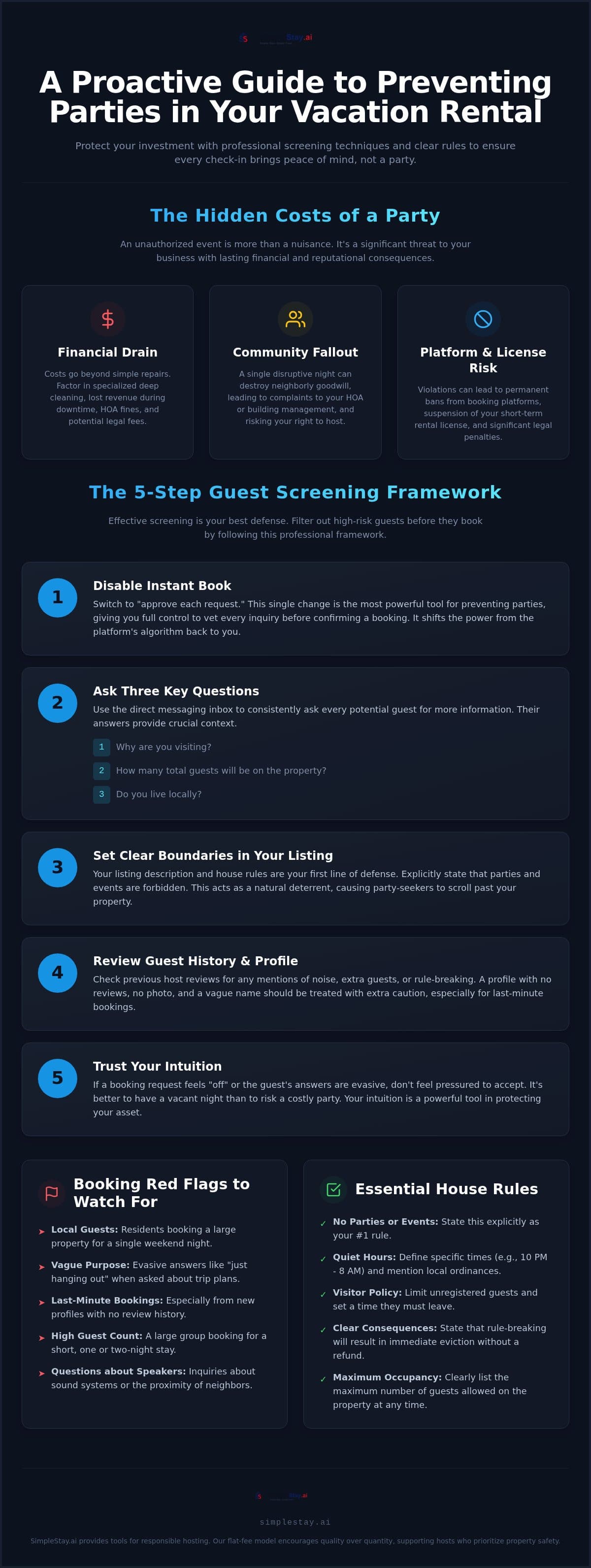
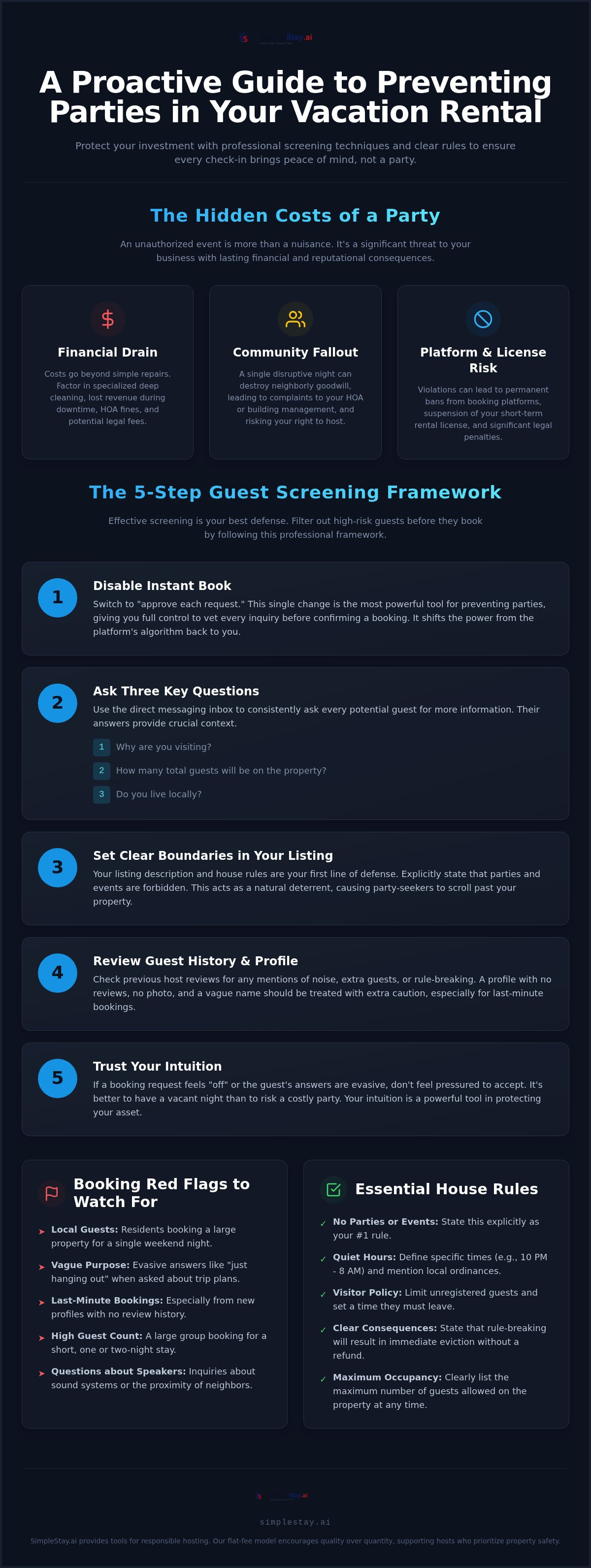
A loud party is more than a nuisance; it's a financial drain. Most hosts think about property damage first, but the hidden costs are often higher. You might face specialized deep cleaning fees for smoke or biohazards. If the damage is severe, you lose revenue during the days or weeks your property is offline for repairs. When preventing parties in vacation rentals, you must account for these operational risks. In the Vacation rental industry, one bad night can also lead to permanent platform bans or hefty fines from your HOA.
Neighbors are your silent partners. One disruptive event can destroy years of goodwill in your local community. In many apartment buildings, a single neighbor complaint to the board can result in the immediate revocation of your right to host. The psychological toll is just as heavy. Many hosts live in constant anxiety, dreading the middle-of-the-night call that signals a loss of control over their home.
Why Traditional Platforms Sometimes Fail Hosts
Commission-based marketplaces often prioritize booking volume over property safety. Because these platforms earn a percentage of every stay, their algorithms frequently reward "Instant Book" settings. This pressures hosts to skip deep screening to maintain their search rankings. Without the right filters, you're essentially leaving your keys under the mat for anyone with a credit card.
Local Regulations in the Dominican Republic
In high-end areas like Piantini in Santo Domingo or gated communities in Punta Cana, noise ordinances are strictly enforced. Fines for "ruido excesivo" can be substantial; repeated violations may lead to legal action. Utilizing professional building security (seguridad) is a major advantage here. A trained guard can act as a first line of defense, preventing unauthorized guest entry before a party even starts. This proactive approach is the foundation for maintaining a safe and profitable rental.
Guest Screening for Vacation Rental Hosts: A 5-Step Framework
Effective screening is the most reliable method for preventing parties in vacation rentals. You don't need expensive noise sensors if you filter out the wrong guests from the start. First, set clear boundaries in your listing description. Explicitly stating that you don't allow events acts as a natural deterrent. Second, disable Instant Book. Using the "approve each request" setting is a vital step in preventing parties in vacation rentals by giving you the control needed to evaluate every person before they arrive.
Ask every potential guest three specific questions: Why are you visiting? How many total guests will be on the property? Do you live locally? Local guests booking a large villa for a single Saturday night are a major red flag. Review their previous host ratings for patterns of disruptive behavior. If a request feels "off," don't feel pressured to accept it. Your intuition is a powerful tool in protecting your investment.
Red Flags to Watch For During Booking
Look for vague responses like "just hanging out" when asked about trip purpose. Be wary of last-minute inquiries from profiles with no history, especially if they have a high guest count. These often indicate a group looking for a venue after other options fell through. You can learn more about managing these risks in our guide on Mastering BNB Hosting in the Dominican Republic.
The Power of Direct Communication
Use the SimpleStay Inbox to establish a professional rapport. A quick message like, "We prioritize a quiet environment for our neighbors; does this fit your group's plans?" sets the tone. For consistency, set up your host profile and draft a standard screening template to use for every inquiry. This ensures you never skip a vital step in your security protocol.
Writing House Rules That Actually Deter Party-Seekers
Your house rules serve as the legal backbone for your property's safety. While screening helps filter out bad actors, clear rules provide the necessary "teeth" to handle issues if they arise. Place an explicit No Parties or Events clause at the very top of your listing. Be specific about quiet hours, typically from 10:00 PM to 8:00 AM, and mention that these align with local noise ordinances. Limiting external visitors is another key tactic for preventing parties in vacation rentals. Clearly state that any guest not included in the original booking must leave the premises by 9:00 PM. Most importantly, define the consequences. State that rule-breaking results in immediate eviction without a refund. This firm stance discourages those looking for a venue rather than a place to stay.
Specific Rules for Dominican Republic Rentals
In the Dominican Republic, building rules often govern common areas and guest entry. Ensure your rules mention that guests must comply with the building administration's policies or mantenimiento guidelines. If your property is in a gated community in Punta Cana or a tower in Santo Domingo, require all visitors to register at the security gate. This adds a layer of accountability that party-seekers typically avoid.
Leveraging Technology for Peace of Mind
Technology can verify compliance without invading guest privacy. Noise-monitoring devices measure decibel levels without recording conversations, alerting you if things get too loud. Pair these with outdoor security cameras at the entrance to monitor guest counts during check-in. You must disclose all cameras in your listing to stay compliant with privacy laws. These tools offer a high-tech approach to preventing parties in vacation rentals while you sleep.
How SimpleStay’s Model Supports Responsible Hosting
SimpleStay changes the power dynamic between platforms and property owners. Traditional sites take a percentage of every booking, which often pressures you to accept every guest to keep your rankings high. Our flat-fee pricing of $50 per month means you don't lose revenue to platform "protection" fees that offer little actual security. By removing the commission, we give you the financial freedom to decline a risky $500 booking without a second thought. This independence is a core component of preventing parties in vacation rentals.
Professionalism is your best defense. The "Verified Host" badge, earned through a Stripe Identity check, signals to guests that you are a legitimate business owner. This transparency attracts respectful travelers while deterring those looking for an unmonitored space. Our manual approval flow ensures you review every request before any money changes hands. This allows you to apply the screening framework discussed earlier without the pressure of an automated system.
Attracting Better Guests with Transparent Pricing
Most platforms add significant service fees to the guest's total. These markups often attract "deal-seekers" who may prioritize price over property respect. SimpleStay offers $0 guest service fees, so the guest's price is exactly what you set. This attracts savvy, high-quality travelers who value transparency and direct communication. You can read more about this in our guide on Zero Booking Fee Vacation Rentals.
Setting Up Your Safety-First Listing on SimpleStay
Building a secure listing is simple. Navigate to the listing editor and choose the "approve each request" option instead of Instant Book. This creates a manual gate for every inquiry. Next, use the house rules section to clearly display your quiet hours and visitor limits. This structure is designed for preventing parties in vacation rentals from the very first click.
Take Control of Your Property's Safety
Protecting your rental from unauthorized events isn't about luck; it's about setting a professional standard. By combining a clear screening framework with house rules that have real consequences, you eliminate the ambiguity that party-seekers exploit. You've learned that preventing parties in vacation rentals starts long before the guest arrives, from the very first message in your inbox to the transparent boundaries set in your listing description.
SimpleStay supports this proactive approach by removing the commission-based pressure to accept every booking. You gain the freedom to say "no" to high-risk requests while keeping 100% of your earnings from the guests you actually want. With a flat $50 monthly subscription and an identity-verified host badge, you can build a secure, professional business on your own terms.
Your peace of mind is worth the effort of a thorough check-in process. We're here to help you host with confidence and protect your investment for the long term.
Frequently Asked Questions
Can I legally evict a guest for throwing a party in a vacation rental?
Yes, but your right to evict depends on local laws and the house rules established before the booking. If your rental agreement explicitly prohibits parties, a violation constitutes a breach of contract. In cities like Orlando or Santo Domingo, you should contact local law enforcement if guests refuse to leave. Always document the disturbance with photos or decibel logs to support your case during the eviction process and any subsequent claims.
Do noise-monitoring devices record guest conversations?
No, privacy-focused noise monitors like Minut don't record actual speech or conversations. These devices measure sound pressure levels in decibels to detect sustained loud noise without capturing private audio. This technology is a vital tool for preventing parties in vacation rentals while respecting guest privacy. Using these monitors allows you to receive real-time alerts on your phone if noise exceeds your pre-set limits, protecting your property in Punta Cana or New York.
Is it okay to ask guests for their reason for visiting?
Asking about the purpose of a trip is a professional part of the screening process. Most respectful travelers are happy to share their plans, such as a family vacation or a business trip. If a guest gives vague answers or becomes defensive, it's often a sign they're hiding their true intentions. Use the SimpleStay Inbox to ask these questions before approving any manual booking request to ensure a safe and respectful stay.
Should I charge a security deposit to prevent parties?
While security deposits provide a financial buffer, they don't always stop a party from happening. SimpleStay doesn't handle security deposits directly; you must agree on these terms with your guest separately. A more effective strategy for preventing parties in vacation rentals is using manual booking approval. This allows you to vet the guest's history before they pay, which is more powerful than a small financial penalty after the damage has already occurred.
What should I do if a neighbor calls about a party in progress?
Take immediate action by contacting the guest through the app to demand the noise stops. If the situation doesn't resolve in minutes, you may need to visit the property or call local security. In Santiago or Miami, the building's seguridad or security patrol is your first point of contact. Always apologize to your neighbor and keep them updated on your steps to resolve the issue and restore community peace.

Article by
Jaime Robledo, MBA
Jaime Robledo, MBA, is a technology leader, entrepreneur, and founder based in Santo Domingo, Dominican Republic, with more than two decades of experience building, modernizing, and securing enterprise technology environments. His career has spanned consulting, media, finance, education, healthcare, and large-scale corporate IT, with deep expertise in Microsoft technologies, cloud infrastructure, endpoint management, automation, cybersecurity, AI, and digital transformation.
Throughout his career, Jaime has led complex technical initiatives involving Microsoft Intune, Microsoft 365, Defender, SCCM, Azure, PowerShell, DevOps, Windows modernization, and enterprise infrastructure. His experience combines hands-on engineering, technical leadership, business strategy, and execution.
Today, Jaime is focused on building technology companies designed specifically for Latin America. He is the founder of SimpleStay.ai, a rental and hospitality platform created to make booking, hosting, rent payments, and property management more transparent and affordable through flat pricing, zero guest service fees, secure payments, identity verification, and support for short-term, hotel, and long-term rentals.
He also built United Empresas, a marketplace connecting customers with local service professionals for discovery, booking, payments, and business growth.
Beginning in January, Jaime will also be building a new fintech platform in public, focused on making digital payments and money movement simpler and more accessible across Latin America.
Across every venture, Jaime’s mission is the same: use technology, AI, automation, and practical business systems to reduce friction, create jobs, strengthen small businesses, expand financial access, and improve people’s lives throughout Latin America.