Publicado em 13 de setembro de 2026
Automating Guest Verification: 2026 Guide for Hosts

How much time did you spend last month chasing guests for blurry ID photos or explaining your house rules? It's often the most draining part of being a host. You want to provide a warm welcome, but the constant fear of unauthorized parties or losing a chargeback dispute keeps you on edge. Manually checking documents isn't just slow; it's prone to human error. That's why automating guest verification for vacation rentals has become the standard for professional hosts who value their time and security.
We agree that your energy is better spent improving your property than playing digital detective. This guide will teach you how to replace manual checks with automated workflows that protect your investment and reduce fraud. We'll explore the best third-party tools for 2026 and show you how to build a set-and-forget system. By the end, you'll know exactly how to professionalize your rental business while keeping your monthly software costs predictable and low. It's time to stop worrying about who is at your door and start focusing on your next five-star review.
Key Takeaways
- Avoid the "Chargeback Trap" by replacing insecure manual ID photos with digital documentation that actually holds up during credit card disputes.
- Discover how automating guest verification for vacation rentals using biometric "selfie" checks protects your home without adding friction for your guests.
- Follow a clear 5-step guide to audit your booking flow and update your house rules for a professional, set-and-forget security system.
- Learn how modern flat-fee platforms simplify your business by including essential identity tools in one predictable monthly subscription.
Table of Contents
Beyond WhatsApp Photos: The Real Risks of Manual Guest Verification
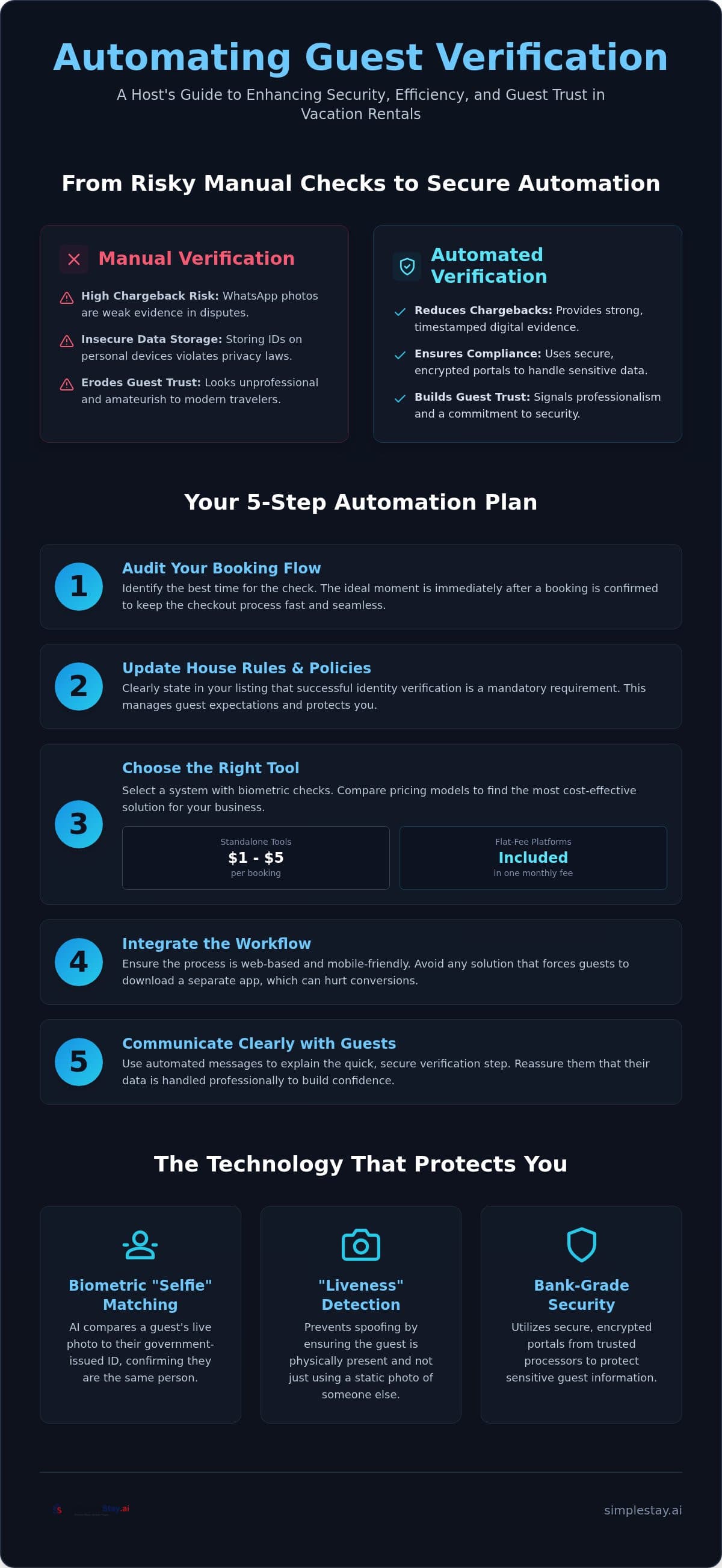
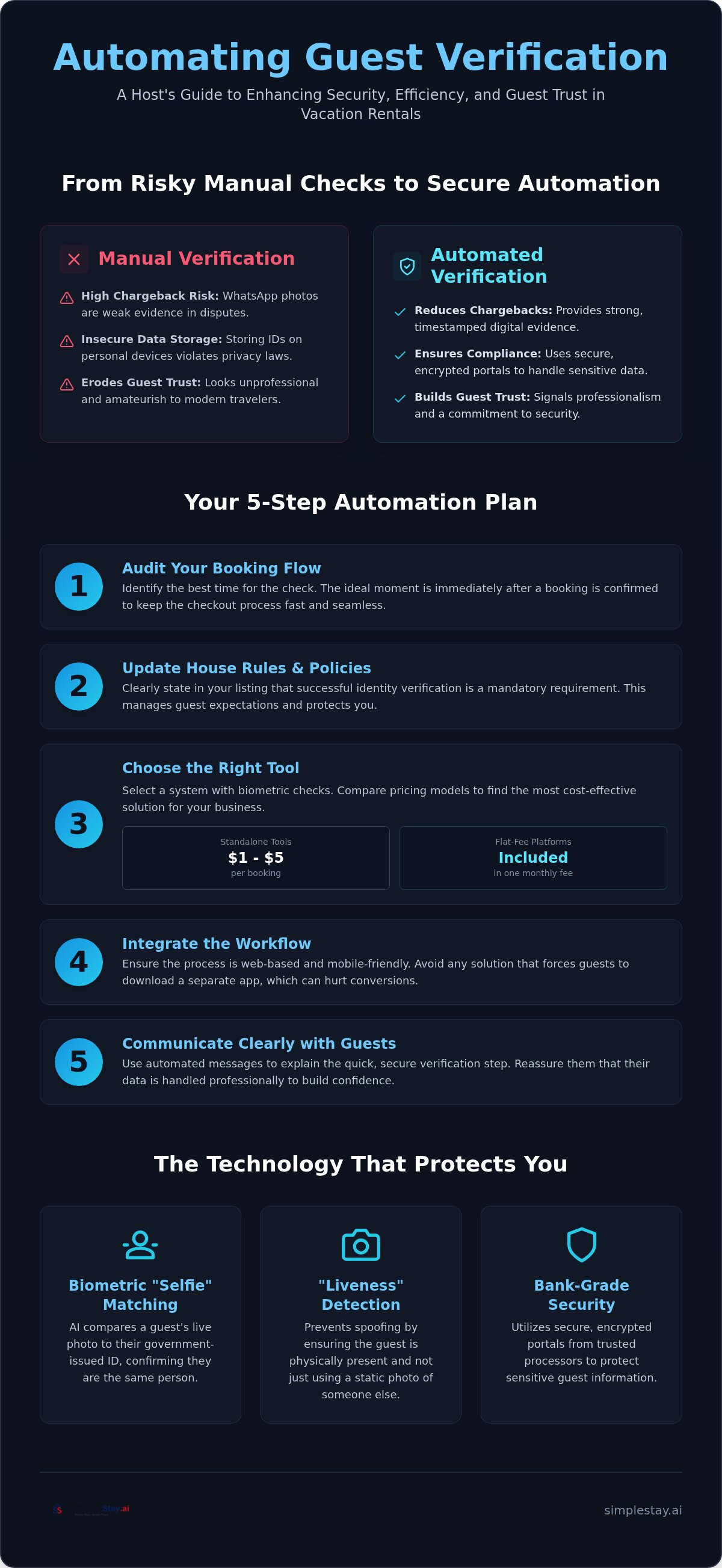
Many hosts still ask guests to text a photo of their passport via WhatsApp. While it feels fast, it's a massive security liability. Storing sensitive ID data on a personal device or in a chat history leaves you vulnerable to data breaches. It also signals an "amateur" operation to high-end travelers who expect professional standards. Automating guest verification for vacation rentals moves these sensitive files away from your personal life and into secure, dedicated environments.
This shift is especially critical in high-growth markets like the Dominican Republic. As fraud patterns evolve, simply looking at a photo isn't enough to stop professional scammers. By adopting Know Your Customer (KYC) principles, you create a digital trail that protects your property. Without this, you fall into the "Chargeback Trap." When a guest disputes a credit card charge, a grainy WhatsApp photo rarely counts as valid evidence. Banks demand verified, timestamped documentation that manual checks can't provide.
Privacy and Compliance Risks
Storing guest IDs in your phone's gallery often violates modern data privacy laws. If your phone is lost or hacked, you're responsible for that leaked information. Automated systems are safer because they encrypt data and delete it after verification, ensuring neither you nor the guest stays at risk.
The Impact on Guest Trust
Modern digital nomads and luxury travelers are wary of identity theft. They prefer secure, encrypted portals over sending sensitive documents through unencrypted chat apps. Displaying a "Verified Host" badge on your profile, which you receive after you sign up as a host and complete your own ID check, instantly builds this trust. It shows you take security seriously, which directly improves your booking conversion rates. Professionalism starts with how you handle a guest's most private information.
Choosing the Right Automated Verification Workflow for Your Rental
Selecting a system isn't just about ticking a security box. You need a workflow that stops fraud without frustrating your guests. A key principle is the "No App" Rule. If a guest has to download a separate app just to verify their identity, they might abandon the booking. Your goal is a web-based, mobile-responsive flow that feels integrated and fast.
Cost is another critical factor. Many standalone tools charge between $1 and $5 per booking. If you manage multiple properties or have high turnover, these fees eat into your ROI quickly. Instead of paying per-check, look for platforms where identity verification is a standard feature of your subscription. This approach turns a variable cost into a predictable monthly expense, making it easier to scale your rental business.
Biometrics and AI: The 2026 Standard
Simple document uploads are no longer enough. Modern scammers use high-quality forgeries that look perfect to the human eye. To combat the risks of rental scams, 2026 standards require biometric "selfie" matching. This technology uses AI to compare a live photo of the guest to their government ID in real-time. It detects "liveness" to ensure the person is actually present. Using bank-grade tools like Stripe Identity ensures you have the same level of security as a major financial institution without needing a tech degree.
Reducing Friction in the Guest Journey
Your verification process should feel like a digital concierge, not a police interrogation. Automating guest verification for vacation rentals allows you to trigger the check immediately after booking. This gives guests plenty of time to complete it before they arrive at your property. For a deeper look at setting this up, check out our guide on Vacation Rental Identity Verification. You can start your 30-day trial today to see how a built-in verification badge builds instant trust with your travelers.
How to Automate Guest Verification: A 5-Step Implementation Guide
Moving from manual checks to an automated system is a one-time project that pays off in hours saved every month. Automating guest verification for vacation rentals requires a logical sequence to ensure you don't lose bookings while staying protected.
- Audit your flow: Identify the best moment for the check. Requesting verification immediately after a booking is confirmed keeps the checkout process fast while ensuring you have the data before check-in.
- Update policies: Your cancellation policy and house rules must clearly state that a successful ID check is a condition of entry.
- Select your platform: Choose a system that sends the verification link automatically so you don't have to remember to do it.
- Sync status: Ensure your dashboard updates the guest's status to "Verified" automatically. This allows you to scan your calendar and see who is ready for arrival at a glance.
- Set a decline protocol: Have a firm rule for non-compliance. If a guest ignores the request for 48 hours, use a template to explain that their stay cannot proceed without verification.
Setting the Stage in Your Listing
Clarity is your best tool for guest satisfaction. Phrase your ID requirement as a standard safety protocol: "To ensure a secure environment for all, we require guests to complete a digital ID check." This prevents the process from feeling like an interrogation. For hosts in high-growth areas, our guide on Mastering BNB Hosting in the Dominican Republic offers deeper insights into local expectations.
Handling Verification Failures
Failures happen for simple reasons like poor lighting or expired documents. Use your Inbox to send a friendly, professional request for a re-scan. If the name on the ID significantly differs from the booking name, ask for clarification. Sticking to your protocol ensures you aren't pressured into skipping security steps for a suspicious reservation.
Predictable Security: Why Flat-Fee Platforms are the Future for Hosts
Traditional booking platforms often penalize your success. As your rental income grows, the commission you pay climbs right along with it. This model makes the cost of security feel like an extra burden. Automating guest verification for vacation rentals shouldn't come with a rising price tag that eats into your ROI. When you factor in 15% to 20% commissions plus external verification software fees, your actual margins shrink quickly.
Simple Stay ai inc offers a different path. We provide a flat $50 monthly subscription per property with 0% commission. This predictable cost includes the identity verification infrastructure through Stripe Identity. You don't have to choose between professional security and profitability. Whether you're managing a single studio or a portfolio of beachfront villas, your overhead remains constant. This transparency allows you to focus on hospitality instead of calculating fluctuating fees.
Scaling Without Penalties
A host earning $3,000 should pay the same security fee as one earning $800. Predictable monthly costs are vital for property managers in competitive markets like Miami, Orlando, and Santo Domingo. You can scale your business without being taxed for your growth. By automating guest verification for vacation rentals through a flat-fee platform, you turn security into a manageable, fixed part of your business plan.
Attracting Verified Stays
Trust is a two-way street in the rental world. The "Verified Host" badge signals to high-quality travelers that you're a professional who prioritizes safety. This is especially important for remote workers and expats looking for 3 to 12 month stays. Since guests pay $0 in service fees on our platform, they see a lower total price for your property. This combination of verified trust and fair pricing attracts guests who value transparency and respect your house rules.
Your rental business deserves a professional foundation that scales without penalties. Take the first step toward a more secure and profitable future today. We're ready to help you host with confidence.
Frequently Asked Questions
Is guest identity verification legal for vacation rentals?
Yes, it's generally legal and often required by local regulations or insurance policies. In cities like New York or Santo Domingo, knowing who is in your property is a standard safety measure. Hosts should check local laws as requirements vary by jurisdiction. Automated systems handle this data more securely than manual storage, helping you stay compliant with modern privacy standards while protecting your home.
Do I need a separate software to verify guest IDs?
Not if you choose a platform that integrates these tools. While some hosts pay for standalone apps, SimpleStay includes identity verification in your flat $50 monthly subscription. This eliminates the need for extra software and keeps your workflow in one place. Automating guest verification for vacation rentals through your booking platform is the most efficient way to manage your properties in Miami or Punta Cana.
What happens if a guest refuses to provide their ID?
You have the right to cancel the booking if your house rules clearly state that verification is mandatory. It's better to lose a single reservation than to risk your property's safety. Professional travelers understand these security steps. If a guest refuses, use the platform's Inbox to explain your policy. If they still won't comply, follow your "Decline" protocol to protect your rental in Orlando or Santiago.
Does guest verification prevent all types of property damage?
No, verification is a risk reduction tool, not a guarantee of perfect behavior. It discourages bad actors and professional scammers who want to remain anonymous. While it won't stop accidental spills, it significantly lowers the chance of unauthorized parties or criminal activity. Combining verification with clear house rules and good communication provides the best protection for your rentals in San Francisco or Puerto Plata.
How does automated verification help with credit card chargebacks?
Automated systems provide a digital paper trail that banks accept as high-quality evidence. If a guest claims they didn't authorize a stay, you can present the verified ID and biometric matching data. This documentation is far more persuasive than a simple email or a grainy photo. It gives you a fighting chance to win disputes and protect your revenue for properties in New York or Punta Cana.
Can I verify guests for long-term rentals (3-12 months) too?
Yes, you can use these tools for any stay duration. SimpleStay allows you to list properties for nightly stays or longer terms like 6 or 12 months. Automating guest verification for vacation rentals and long-term stays ensures that every person entering your home has been checked. This is especially useful for remote workers or expats in Santo Domingo who need a secure, verified place to live for several months.

Article by
Jaime Robledo, MBA
Jaime Robledo, MBA, is a technology leader, entrepreneur, and founder based in Santo Domingo, Dominican Republic, with more than two decades of experience building, modernizing, and securing enterprise technology environments. His career has spanned consulting, media, finance, education, healthcare, and large-scale corporate IT, with deep expertise in Microsoft technologies, cloud infrastructure, endpoint management, automation, cybersecurity, AI, and digital transformation.
Throughout his career, Jaime has led complex technical initiatives involving Microsoft Intune, Microsoft 365, Defender, SCCM, Azure, PowerShell, DevOps, Windows modernization, and enterprise infrastructure. His experience combines hands-on engineering, technical leadership, business strategy, and execution.
Today, Jaime is focused on building technology companies designed specifically for Latin America. He is the founder of SimpleStay.ai, a rental and hospitality platform created to make booking, hosting, rent payments, and property management more transparent and affordable through flat pricing, zero guest service fees, secure payments, identity verification, and support for short-term, hotel, and long-term rentals.
He also built United Empresas, a marketplace connecting customers with local service professionals for discovery, booking, payments, and business growth.
Beginning in January, Jaime will also be building a new fintech platform in public, focused on making digital payments and money movement simpler and more accessible across Latin America.
Across every venture, Jaime’s mission is the same: use technology, AI, automation, and practical business systems to reduce friction, create jobs, strengthen small businesses, expand financial access, and improve people’s lives throughout Latin America.